Hamas War

Showing posts with label Torah Portion of the Week. Show all posts

Tuesday, June 2, 2026

Book Review: Making It Relevant, Very True


Making It Relevant by Katia Bolotin is a very readable Parshat Shavua, Torah Portion of the Week, book. A few meaningful concepts and commentaries per Torah Portion are included, and each chapter ends with a few additional points for Making It Relevant plus some guiding words. 

The words of wisdom can been just for one's own knowledge and pleasure or to read at the Shabbat table or for teaching one's children. 

Katia Bolotin is multi-talented for sure. Besides writing this wonderful Torah book, she's a pianist and song-writer. 

Something that really impressed me is, davka, her chapter on Shlach, the  parsha being read this coming Shabbat in Israel and the following week in Chutz La'Aretz. Unlike the vast majority of commentators she correctly refers to the twelve man delegation to scout out the Land as "leaders" of the twelve tribes. That was their position; there's no indication in the Torah that they were to be "spies." The incorrect reference to them as "spies" is one of my biggest pet peeves when it comes to Biblical commentary. I'm really glad that Bolotin follows the text carefully and accurately. 

Bolotin gives us some very interesting approaches to the various Torah Portions. This isn't your ordinary Parsha book. In Parshat Pinchas she relates to Tzlofchad's daughters to modern women's rights reminding us that not all that long ago women couldn't own property. Tzlofchad had died without having any sons, and his daughters wanted to inherit what would have been their father's land. Moshe was in a quandary and didn't know what to say, so he consulted with Gd who agreed with Tzlofchad's daughters. Yes, Judaism, even in most ancient times, gave women more rights than many countries even just over a century ago.

As you can see I find Making It Relevant very inspiring. I highly recommend it for yourself and as gifts. You can order it from Mosaica Press or Amazon.

Monday, June 19, 2023

Parshat Korach, Why So Many Sins So Soon After Magnificent Mt Sinai Experience?

Korach


At my local women's Parshat Shavua, Korach, class among friends and neighbors, the classic question came up:

Why So Many Sins So Soon After Magnificent Mt Sinai Experience?

My mind began turning out ideas...

I found myself back in May-June, 1967 hearing the threats of Egypt's Nasser, unabashedly saying that he'll destroy the State of Israel, shove it into the sea...

Egypt's Nasser demanded that the United Nations remove the Peacekeeping Forces, and for all practical purposes the UN replied:

"Yesterday? At your service."

No country offered any help to Israel. They just waited around, mouthing platitudes at best, not wanting to get in the way of the bullets while Israel was being pushed into the sea. Jews, and possibly a few other good souls, prayed, and then a miracle of Biblical proportions happened. In six days, yes, just six 6 days, Israel managed to defeat three stronger better equipped armies, and in the process found itself holding more land on each of three fronts, the Golan formerly Syrian in the north, the Sinai formerly Egyptian in the south and to the east our Jewish Biblical Homeland traditionally called Judea and Samaria, though the Jordanians had referred to it as the "west bank."

And what did Israel's government do? 

  • Did it declare sovereignty, like any normal self-respecting country would do? 
  • Did the Jewish religious leaders declare a massive national prayer of thanks to Gd on the Temple Mount? No, 

Moshe Dayan gave the Muslims the key to the Temple Mount, reassuring them that Israel wouldn't disturb/trespass on their religious site and the political leaders made it clear to the defeated Arab countries that we'd be happy to give back most of the land in exchange for "peace."

We're still suffering the ramifications of those dangerous and foolish policies. Unfortunately, nothing's new. Human nature isn't perfect. Think of all the Jews who could have left Europe before the Holocaust.. Think of the Jewish leaders who not only opposed Zionism but condemned it.

Sunday, June 11, 2023

Parshat Shlach Lecha פרשת שלח לך

A bit of Parshat Shavua, Torah Portion of the Week. 

My interpretation/translation of the word/verb וְיָתֻ֙רוּ֙ "yaturu" isn't "scout," it's "stake out." 

In modern terms, we can say that Gd sent the twelve tribal leaders on "pilot trip" to choose which part of the land of Israel each tribe would settle when arriving in the Holy Land. They were to decide according to the which suited each tribe, and that's the "judgements" they were to make. 

Unfortunately, ten out of twelve thought they had the authority to decided whether or not to bring their tribal members into the land, claiming it too dangerous. 

For that sin, they and their generation had to die and only the next generation entered the Holy Land. The two exceptions were the leader who had followed orders, Caleb and Yehoshua.

Sunday, January 30, 2022

Parshat Shavua Mishpatim, עבד "Evved," Slave or Just Employee?


פרשת משפטים Parshat Shavua Mishpatim

Shmot Chapter 21:1

"And these ae the laws..."

Parshat Shavua Mishpatim begins with laws about employment, the rights of the employee. OK, I know that everybody else translates עֶ֣בֶד as "slave." But last week as I read over the chapters before attending our local zoom parsha class, the meaning seemed very clear. The avaddim aren't slaves like the Africans who had been brought to America to work for the Europeans were until Abraham Lincoln had them freed. 

What's called the evved Ivri, Jewish/Hebrew slave wasn't a slave "imported" from another location bought at an auction or from some agent. He/She was someone who was poverty stricken and couldn't live off of his land. Remember that the Land of Israel had just been divided among the tribes, and each tribe had gotten its portion and each portion was to be divided among the clans. The laws here had been designed by Gd for the Jewish People in their Holy Land. I like to try to understand the Tanach and Hebrew according to how life was at the time.

Some of us have worked at jobs with difficult conditions. Many Sabbath observers who made it to America had to start new jobs every week, since they were automatically fired when they left early on Friday after announcing that they wouldn't be showing up on Saturday. I don't now about you, but employment conditions at some of my old jobs gave me a choice of very difficult hours/conditions or being fired. 

Few jobs allow employees to take vacation whenever they want and for however long they want. Keep that in your head when Moshe and Aharon demand that all the workers should leave at the same time.

And changing work conditions... I remember when the high school where I had been teaching English suddenly gave us fewer hours per week to teach the same material to the same number of students. After that they gave two double lessons on consecutive days instead of spreading out the teaching hours to give the students, especially my weak ones, a chance to really absorb the curriculum. Yes, that's like how Pharaoh told them to make bricks without providing the necessary straw.

Here Gd is demanding humane working conditions for employees. Proof that there's nothing slave-like in being an "evved" is that their employment contract is mandated by Gd to end after a maximum of six years. 

Think about it. That's not slavery!

Saturday, December 4, 2021

Parshat Shavua: Did Reuven Know What Happened to Yosef?

Last week after reading in Parshat Vayeshev I wondered if anyone ever told Reuven, Yaakov's first born son, what had happened to his young annoying brother Yosef. 

Yaakov, their father, had sent Yosef to visit with his older brothers, which didn't make them very happy. In reaction, Reuven tried to get him out of the way, to safety in his mind, by putting him in a waterless pit. Soon after Reuven had to leave the group for a short time. While he was away, at the instigation of Yehuda, they sold Yosef to passing merchants. When Reuven returned he was horrified to discover Yosef's disappearance, and then the other brothers quickly covered his special coat with blood to make it appear that he had been taken by a violent animal. Nothing is said to Reuven about what had really been done to Yosef. I began asking Tanach teachers if I had missed something. The only response:

 "Good question."

This Shabbat I very carefully read Parshat Mikeitz hoping for enlightenment. I found two verses in Chapter 42:


At this point, Yosef, disguised as an Egyptian, had insisted that if the brothers want to buy more necessary food in Egypt, they must return with their youngest brother, Binyamin. The brothers know that after the loss of Yosef, their father would never agree. In Bereishit 43:22 Reuven says that they're in this situation because of the blood of Yosef, whom he still thinks is dead: 

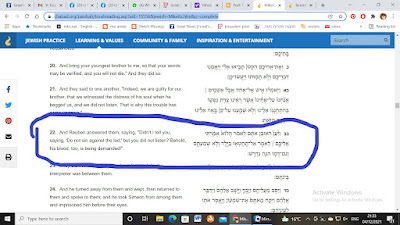
22: And Reuben answered them, saying, "Didn't I tell you, saying, 'Do not sin against the lad,' but you did not listen? Behold, his blood, too, is being demanded!" כב: וַיַּ֩עַן֩ רְאוּבֵ֨ן אֹתָ֜ם לֵאמֹ֗ר הֲלוֹא֩ אָמַ֨רְתִּי אֲלֵיכֶ֧ם | לֵאמֹ֛ר אַל־תֶּֽחֶטְא֥וּ בַיֶּ֖לֶד וְלֹ֣א שְׁמַעְתֶּ֑ם וְגַם־דָּמ֖וֹ הִנֵּ֥ה נִדְרָֽשׁ:

Reuven's conviction that Yosef had been killed is most probably behind his incomprehensible "pledge" to his father when trying to get permission to bring Binyamin to Egypt: 

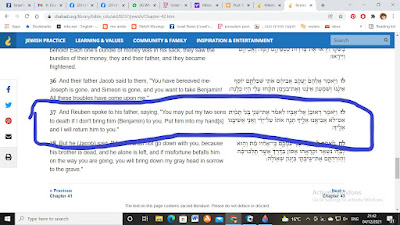
37: And Reuben spoke to his father, saying, "You may put my two sons to death if I don't bring him (Benjamin) to you. Put him into my hand[s] and I will return him to you." לז: וַיֹּ֤אמֶר רְאוּבֵן֙ אֶל־אָבִ֣יו לֵאמֹ֔ר אֶת־שְׁנֵ֤י בָנַי֙ תָּמִ֔ית אִם־לֹ֥א אֲבִיאֶ֖נּוּ אֵלֶ֑יךָ תְּנָ֤ה אֹתוֹ֙ עַל־יָדִ֔י וַֽאֲנִ֖י אֲשִׁיבֶ֥נּוּ אֵלֶֽיךָ:

Reuven's offer to lose two sons was to parallel his father's loss. Obviously, Yaakov didn't accept the offer. What father/grandfather would. Afterwards he did accept Yehuda's pledge, though neither he nor Reuven had a clue that it was Yehuda who was the cause of Yosef's disappearance. 

Friday, October 8, 2021

Parshat Noach: Confusing/Distorting English Translation...

Chabad online Tanach

Yesterday when I was preparing for a Parshat Shavua, Torah Portion of the week class my neighbor teaches, I got "confused," sort of. 

First I must admit that I read it in English, even though we study in Hebrew. That's not usually a problem. When it comes to reading, my English is far superior to my Hebrew, but when I find something "peculiar," I check the Hebrew.


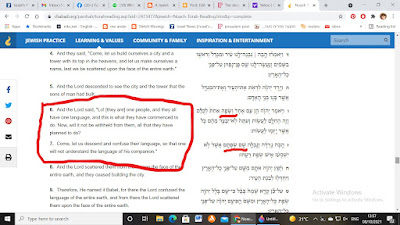
Please read the two circles sections. Concerning the descendants of Noach/Noah, Chapter 10, it says that they spoke multiple languages, blue circle. The sin/story of Migdal Bavel, the Tower of Babel ends with the builders punished by their speaking multiple languages instead of one. Look at what's in the red circle.

Both circled sections use the word language. It makes no sense.

So I decided to check out the Hebrew. Chapter 10 uses the word לשון lashon, tongue, while Chapter 11 uses שפה saffa, lip.

Translation isn't Mathematics. 1 is one, uno, achad etc. But as in one of my linguistic pet peeves, the Hebrew סרוג\סרוגה sarug/srugah can mean either knitting or crocheting which are not the same.

So my question is:

What's the difference between לשון lashon and שפה saffa when it comes to language? Not as parts of the mouth, which are obvious.


Saturday, June 13, 2020

The "Pilot Trip" That Went Very Wrong, Parshat Shlach Lecha


This week's Parshat Shavua, Torah Portion of the Week Shlach Lecha is basically about a "Pilot Trip" to the Holy Land that ended up being a disaster.

Gd had instructed Moshe to send out a very distinguished delegation of tribal leaders to divvy up the Land in advance of the big return. Today it's called a "pilot trip." Potential olim, those Jews moving to Israel, are encouraged to send an "advance team or delegate" to choose a suitable location, schools and even arrange housing. Of the twelve tribal leaders Moshe had sent, only Calev followed instructions exactly.
24But as for My servant Caleb, since he was possessed by another spirit, and he followed Me, I will bring him to the land to which he came, and his descendants will drive it[s inhabitants] out.
 
כדוְעַבְדִּ֣י כָלֵ֗ב עֵ֣קֶב הָֽיְתָ֞ה ר֤וּחַ אַחֶ֨רֶת֙ עִמּ֔וֹ וַיְמַלֵּ֖א אַֽחֲרָ֑י וַֽהֲבִֽיאֹתִ֗יו אֶל־הָאָ֨רֶץ֙ אֲשֶׁר־בָּ֣א שָׁ֔מָּה וְזַרְע֖וֹ יֽוֹרִשֶֽׁנָּה:
Their mission wasn't to judge the pros and cons of entering the Land, just to be pragmatically prepared.

Today it's the same. Israel in just over seventy years has become one the most advanced countries in the world. Gd has helped us win our wars, because Gd wants all Jews to live here. Don't make the mistake of the ten tribal leaders who sinned. Be like Calev and Joshua. Pack your bags and stake out your place in the Holy Land, The Land of Israel.


Sunday, May 17, 2020

Parshat Shavua Bahar, The Connection of Shmitta to Mt Sinai


I'm certainly not competing with the venerable and respected Rashi, but a half a century after making aliyah, moving to Israel, I definitely see a strong connection between Shmitta and Mt Sinai.

The connection between Shmitta and Mt Sinai is very simple. It's the paramount centrality of the Land of Israel to the foundation of Torah and Mitzvot. Since there are mitzvot that can only be observed in the Land of Israel, all Jews should be living here.


Vayikra - Leviticus - Chapter 25

1And the Lord spoke to Moses on Mount Sinai, saying,
אוַיְדַבֵּ֤ר יְהֹוָה֙ אֶל־משֶׁ֔ה בְּהַ֥ר סִינַ֖י לֵאמֹֽר:
on Mount Sinai: What [special relevance] does the subject of Shemittah [the “release” of fields in the seventh year] have with Mount Sinai? Were not all the commandments stated from Sinai? However, [this teaches us that] just as with Shemittah, its general principles and its finer details were all stated from Sinai, likewise, all of them were stated-their general principles [together with] their finer details-from Sinai. This is what is taught in Torath Kohanim (25:1). [And why is Shemittah used as the example to prove this rule, especially since the very fine details are not even specified here (Sefer Hazikkaron)?] It appears to me that its explanation is as follows: [At the plains of Moab, Moses reiterated the majority of the laws of the Torah to the Israelites before their entry into the land of Israel, this reiteration comprising most of the Book of Deuteronomy. Now,] since we do not find the laws of Shemittah [“release”] of land reiterated on the plains of Moab in Deuteronomy, we learn that its general principles, finer details, and explanations were all stated at Sinai. Scripture states this [phrase] here to teach us that [just as in the case of Shemittah,] every statement [i.e., every commandment] that was conveyed to Moses came from Sinai, [including] their general principles and finer details [and that the commandments delineated in Deuteronomy were merely] repeated and reviewed on the plains of Moab [not originally given there].
בהר סיני: מה ענין שמיטה אצל הר סיני, והלא כל המצות נאמרו מסיני, אלא מה שמיטה נאמרו כללותיה ופרטותיה ודקדוקיה מסיני, אף כולן נאמרו כללותיהן ודקדוקיהן מסיני, כך שנויה בתורת כהנים. ונראה לי שכך פירושה לפי שלא מצינו שמיטת קרקעות שנשנית בערבות מואב במשנה תורה, למדנו שכללותיה ופרטותיה כולן נאמרו מסיני, ובא הכתוב ולמד כאן על כל דבור שנדבר למשה שמסיני היו כולם כללותיהן ודקדוקיהן, וחזרו ונשנו בערבות מואב:

2Speak to the children of Israel and you shall say to them: When you come to the land that I am giving you, the land shall rest a Sabbath to the Lord.
בדַּבֵּ֞ר אֶל־בְּנֵ֤י יִשְׂרָאֵל֙ וְאָֽמַרְתָּ֣ אֲלֵהֶ֔ם כִּ֤י תָבֹ֨אוּ֙ אֶל־הָאָ֔רֶץ אֲשֶׁ֥ר אֲנִ֖י נֹתֵ֣ן לָכֶ֑ם וְשָֽׁבְתָ֣ה הָאָ֔רֶץ שַׁבָּ֖ת לַֽיהֹוָֽה:
a Sabbath to the Lord: For the sake of the Lord, just as is stated of the Sabbath of Creation (see Exod. 20:10) [i.e., just as every seventh day is a holy Sabbath day, acclaiming that God Himself rested on the seventh day and thus acclaiming that God is the Supreme Creator of all existence, likewise, man must rest from working the land on the seventh year, for the sake of God, not for the sake of the land, so that it should gain fertility by lying fallow for a year]. — [Sifthei Chachamim ; Torath Kohanim 25:7]
שבת לה': לשם ה', כשם שנאמר בשבת בראשית:

3You may sow your field for six years, and for six years you may prune your vineyard, and gather in its produce,
גשֵׁ֤שׁ שָׁנִים֙ תִּזְרַ֣ע שָׂדֶ֔ךָ וְשֵׁ֥שׁ שָׁנִ֖ים תִּזְמֹ֣ר כַּרְמֶ֑ךָ וְאָֽסַפְתָּ֖ אֶת־תְּבֽוּאָתָֽהּ:

4But in the seventh year, the land shall have a complete rest a Sabbath to the Lord; you shall not sow your field, nor shall you prune your vineyard.
דוּבַשָּׁנָ֣ה הַשְּׁבִיעִ֗ת שַׁבַּ֤ת שַׁבָּתוֹן֙ יִֽהְיֶ֣ה לָאָ֔רֶץ שַׁבָּ֖ת לַֽיהֹוָ֑ה שָֽׂדְךָ֙ לֹ֣א תִזְרָ֔ע וְכַרְמְךָ֖ לֹ֥א תִזְמֹֽר:
Yes, I understand that for even the most Torah observant and learned Jew living out of the Land of Israel, the Laws of Shmitta appear theoretical and even irrelevant. This was certainly even more so a thousand years ago, the time of Rashi, when nobody could seriously envision fruitful Jewish agriculture and a Jewish State in the Holy Land, Land of Israel. Christian crusaders had been invading and destroying much of the Land of Israel in the name of their god. Jewish Life was under attack all over the world, especially in the Holy Land. Christian and Muslim theologians needed to prove that Judaism was dead and they were the god appointed replacements. Of course, they would then have to fight each other for the ultimate title.

A hundred and fifty years ago the Zionist Movement brought a new relevance to Shmitta and all other Torah Commandments, mitzvot that can only be observed in the Land of Israel. Close to three years ago I reviewed Rebels in the Holy Land - Mazkeret Batya - An Early Battleground for the Soul of Israel, which tells of how the pioneers who established Mazkeret Batya risked everything to revive the mitzvah of Shmitta.

Poskim, rabbis who are considered as qualified/learned to make decisions based on the Torah, must look seriously at the new realities of today and not base their decisions on Jewish Life of a thousand years ago, a hundred years ago, before the Establishment of the State of Israel and even before Israel's miraculously victory in the Six Days War. The Establishment of the State of Israel and the post-Six Day War were major game-changers for the Jewish People. Gd gave us the Torah to be lived in our world, not to be rooted to the past. We are now sovereign in the Land of Israel, and it's time for all Jews to come home. Otherwise, you may miss the boat.

Sunday, December 8, 2019

Words Can Be Dangerous, A Lesson From Torah Portions "Vayeitzei," and "Vayishlach"

Torah Portion "Vayeitzei" which begins in Bereishit Chapter 28:10 tells the saga of Jacob after he left his parents' home. It includes his "nap" in Beit El, marrying his two wives and the birth of most of his children.

Two dangerous things are said, one by Jacob and one by Rachel, which foretell or cause a tragedy.


First Rachel blames Jacob for her barrenness, rather than praying to Gd. Very dramatically she states:
וַתֵּ֣רֶא רָחֵ֗ל כִּ֣י לֹ֤א יָֽלְדָה֙ לְיַעֲקֹ֔ב וַתְּקַנֵּ֥א רָחֵ֖ל בַּאֲחֹתָ֑הּ וַתֹּ֤אמֶר אֶֽל־יַעֲקֹב֙ הָֽבָה־לִּ֣י בָנִ֔ים וְאִם־אַ֖יִן מֵתָ֥ה אָנֹֽכִי׃
When Rachel saw that she had borne Jacob no children, she became envious of her sister; and Rachel said to Jacob, “Give me children, or I shall die.”
And later in the Torah Portion, when Jacob and his family are fleeing Lavan, Lavan chases after them angry about two things. One is that Jacob left, and the other is that his personal idols had apparently been stolen by someone in Jacob's entourage.
וַיַּ֥עַן יַעֲקֹ֖ב וַיֹּ֣אמֶר לְלָבָ֑ן כִּ֣י יָרֵ֔אתִי כִּ֣י אָמַ֔רְתִּי פֶּן־תִּגְזֹ֥ל אֶת־בְּנוֹתֶ֖יךָ מֵעִמִּֽי׃
Jacob answered Laban, saying, “I was afraid because I thought you would take your daughters from me by force.
עִ֠ם אֲשֶׁ֨ר תִּמְצָ֣א אֶת־אֱלֹהֶיךָ֮ לֹ֣א יִֽחְיֶה֒ נֶ֣גֶד אַחֵ֧ינוּ הַֽכֶּר־לְךָ֛ מָ֥ה עִמָּדִ֖י וְקַֽח־לָ֑ךְ וְלֹֽא־יָדַ֣ע יַעֲקֹ֔ב כִּ֥י רָחֵ֖ל גְּנָבָֽתַם׃
But anyone with whom you find your gods shall not remain alive! In the presence of our kinsmen, point out what I have of yours and take it.” Jacob, of course, did not know that Rachel had stolen them.

I'm sure that you all know the result. In "Vayishlach" Rachel dies after giving birth to Binyamin. Gd turned her threat around. Rachel died from giving birth, not as a result of being barren. Jacob predicted her death in his very "Yiftach* moment" by declaring that someone must die without realizing the power of his words.

Every word has power, and I also see shadows of Rachel's threat in the failures of her descendant King Saul. Contrast Rachel and the names she gave her children with her sister Leah, who recognized Gd's power in the names she gave her children. King David is clearly her descendant and the leader most fitting to lead the Jewish People and produce the Moshiach.
*Judges 11וַיִּדַּ֨ר יִפְתָּ֥ח נֶ֛דֶר לַיהוָ֖ה וַיֹּאמַ֑ר אִם־נָת֥וֹן תִּתֵּ֛ן אֶת־בְּנֵ֥י עַמּ֖וֹן בְּיָדִֽי׃
And Jephthah made the following vow to the LORD: “If you deliver the Ammonites into my hands,
וְהָיָ֣ה הַיּוֹצֵ֗א אֲשֶׁ֨ר יֵצֵ֜א מִדַּלְתֵ֤י בֵיתִי֙ לִקְרָאתִ֔י בְּשׁוּבִ֥י בְשָׁל֖וֹם מִבְּנֵ֣י עַמּ֑וֹן וְהָיָה֙ לַֽיהוָ֔ה וְהַעֲלִיתִ֖הוּ עוֹלָֽה׃ (פ)
then whatever comes out of the door of my house to meet me on my safe return from the Ammonites shall be the LORD’s and shall be offered by me as a burnt offering.”

Sunday, November 17, 2019

Parshat Shavua Vayeira, Akeidat Yitzchak, Testing Issac

Bereishit, Genesis 22, Vayeira
We could spend a whole year studying the Torah Portion Vayeira, and I've written about it before. There's so much in it, narrative, theology etc. One of my pet peeves is the totally inaccurate translation of the term  עֲקֵדַת יִצְחָק, Akeidat Yitzchak, as the "Sacrifice" of Issac. Issac wasn't sacrificed, wasn't killed. The more accurate meaning of the word is "binding," and here it's not in a physical sense. Issac proved his commitment to Gd, so he could follow his father Abraham as leader of the new nation.

I believe that Abraham understood that this was a Divine test. It was already clear to everyone that his older son Ishmael didn't have any of the necessary characteristics needed to lead, but Issac had to be put to a very serious test.

As parents, we sometimes must witness our children's struggles. We can't take their place or stop it. It wasn't easy for our forefather Abraham to cooperate administrating this frightening test on his beloved son. But he played the role perfectly, and that's why Gd praised him afterwards.

Abraham was then able to "retire" as "national leader," but he still had to marry off Issac. More about that next week in חיי שרה Chayei Sarah, the Lifetime of Sarah.

Monday, November 4, 2019

The Tower of Babel and "The Twilight Zone." Parshat Noah

This past Shabbat's Torah Portion of the Week was Noach, or Noah. There are lots of topics in this Parsha, the flood, rainbow, Tower of Babel, antecedents of Abraham and Sarah and more. At our "Parshat Shavua Group," led by a neighbor, we discussed the sin that angered Gd in the "Tower of Babel" story.

In all honesty, I can't quite remember all the details, since my mind kept exploding with inspiration and ideas as she and others spoke. She read from an article that the late Rav Neria had written about it in which he mentioned the difference between  אחדות ואחידות, achdut viachidut, unity and uniformity. Unity is good, but uniformity אחידות achidut isn't. In both Hebrew and English both words seem almost the same. They are from the same linguistic roots meaning "one."

I was warned not to get into politics. You must know that a mantra of mine in recent years is:
Liberals aren't liberal.
We see this all over the world. Those who ascribe to the Liberal philosophies are horrendously intolerant. Socialism evolved into Communism which ran countries with very tight fists and forbade religions. And today Leftist leaning universities, politicians etc call those who disagree with their philosophies and leaders "wrong" rather than respecting the rights of others to other opinions.

When I was still a rather impressionable youngster, I'd watch the iconic and legendary television show The Twilight Zone. One episode has stayed strongly rooted in my mind for over half a century. It was set in the "future." This was a very regimented time, when even home libraries were limited to "approved books only." And not only were books censured, but people had to dress and look in the required way. At a certain age everyone was to choose a certain face from a catalog and submit to surgery. The episode told of a family of rebels which had forbidden books, and their daughter refused to submit to the surgery. They refused to conform to the uniformity of society. Finally the authorities seized the daughter, brought her to the hospital and operated. As I remember it we were shown her reactions as the bandages are being removed. She looks in the mirror for the first time at her new face:
"Oh, how pretty I look." She said sounding amazed and pleased. Then she looked at the woman who was holding the mirror for her and continued. "And best of all, I look just like you."
Light faded; the show ended. I'll never forget it. When they gave her the uniform catalog face, they also changed her brain, her independent mind implanting something to make her a complete law-abiding conformist.

Gd created us humans with Free Will, even though it meant that not all humans would follow Gd's laws. We're challenged by Gd to overcome our Evil Inclinations, which tempt us to conform to human philosophies and ideologies, rather than Gd's laws.

We're supposed to be united under Gd, for Gd and help others. The Sin of the Tower of Babel was that they made their own language, laws and morality. By creating a new language and building a tower they considered godly, they rejected Gd as Supreme Being and Commander.

We must unite under Gd not unify to defy Gd.

In Matan we learn as one, unified, united but not in a uniform. No uniformity

Sunday, October 6, 2019

Parshat Shavua Thoughts, Is "Vayelech" Connected to "Lech Lecha?"

Genesis/Bereishit 12
לך לך Lech Lecha
1 וַיֹּ֤אמֶר יְהוָה֙ אֶל־אַבְרָ֔ם לֶךְ־לְךָ֛ מֵאַרְצְךָ֥ וּמִמּֽוֹלַדְתְּךָ֖ וּמִבֵּ֣ית אָבִ֑יךָ אֶל־הָאָ֖רֶץ אֲשֶׁ֥ר אַרְאֶֽךָּ׃
The LORD said to Abram, “Go forth from your native land and from your father’s house to the land that I will show you.
2 וְאֶֽעֶשְׂךָ֙ לְג֣וֹי גָּד֔וֹל וַאֲבָ֣רֶכְךָ֔ וַאֲגַדְּלָ֖ה שְׁמֶ֑ךָ וֶהְיֵ֖ה בְּרָכָֽה׃
I will make of you a great nation, And I will bless you; I will make your name great, And you shall be a blessing.

Dvarim 31
וילך Vayelech1 וַיֵּ֖לֶךְ מֹשֶׁ֑ה וַיְדַבֵּ֛ר אֶת־הַדְּבָרִ֥ים הָאֵ֖לֶּה אֶל־כָּל־יִשְׂרָאֵֽל׃
Moses went and spoke these things to all Israel.
...
וַֽיהוָ֞ה ה֣וּא ׀ הַהֹלֵ֣ךְ לְפָנֶ֗יךָ ה֚וּא יִהְיֶ֣ה עִמָּ֔ךְ לֹ֥א יַרְפְּךָ֖ וְלֹ֣א יַֽעַזְבֶ֑ךָּ לֹ֥א תִירָ֖א וְלֹ֥א תֵחָֽת׃ 8
And the LORD Himself will go before you. He will be with you; He will not fail you or forsake you. Fear not and be not dismayed!”
Both Lech Lecha and Vayelech have the same linguistic root, (ה ל כ (ך heh, lamed, chof, to go.

In Bereishit, which is in the beginning of the Bible/Torah, Gd tells Abram (Abraham) to go to a land of Gd's choosing, and Gd will make him a great nation. Then in one of the very last lines in the Torah, Moshe went (past tense of "go") to the Jewish People, those descended from Abram and reminds them that Gd will always be with them, and they shouldn't lose confidence.

While the politicians here in Israel are fighting over positions and honors, we must never forget that our TRUE LEADER  is GD ALMIGHTY. It's Gd who protects us, not the IDF or Iron Dome. Last week we celebrated, Rosh Hashanah, the beginning of the Jewish Year, and this week we'll be praying and fasting on Yom Kippur, beseeching Gd to forgive our sins.

May all the Jewish People return to genuine Jewish Life, of Mitzvot and kindness to one another here in the Land Gd gave us.

גמר חתימה טובה
Gmar Chatimah Tovah
May Gd Accept Our Prayers 


Tuesday, September 17, 2019

A Different Look at "Zachor"


I had been debating on whether or not to post this on "A  Jewish Grandmother." That's not because Torah and Parshat Shavua belong more on my other blog. It's just that I wanted my Israeli Elections 2019 posts to stay on top. But my messages/commentaries about "Zachor" really belong here.
דברים כה Dvarim 25
זָכ֕וֹר אֵ֛ת אֲשֶׁר־עָשָׂ֥ה לְךָ֖ עֲמָלֵ֑ק בַּדֶּ֖רֶךְ בְּצֵאתְכֶ֥ם מִמִּצְרָֽיִם׃
Remember what Amalek did to you on your journey, after you left Egypt—
אֲשֶׁ֨ר קָֽרְךָ֜ בַּדֶּ֗רֶךְ וַיְזַנֵּ֤ב בְּךָ֙ כָּל־הַנֶּחֱשָׁלִ֣ים אַֽחַרֶ֔יךָ וְאַתָּ֖ה עָיֵ֣ף וְיָגֵ֑עַ וְלֹ֥א יָרֵ֖א אֱלֹהִֽים׃
how, undeterred by fear of God, he surprised you on the march, when you were famished and weary, and cut down all the stragglers in your rear.
וְהָיָ֡ה בְּהָנִ֣יחַ יְהוָ֣ה אֱלֹהֶ֣יךָ ׀ לְ֠ךָ מִכָּל־אֹ֨יְבֶ֜יךָ מִסָּבִ֗יב בָּאָ֙רֶץ֙ אֲשֶׁ֣ר יְהוָֽה־אֱ֠לֹהֶיךָ נֹתֵ֨ן לְךָ֤ נַחֲלָה֙ לְרִשְׁתָּ֔הּ תִּמְחֶה֙ אֶת־זֵ֣כֶר עֲמָלֵ֔ק מִתַּ֖חַת הַשָּׁמָ֑יִם לֹ֖א תִּשְׁכָּֽח׃ (פ)
Therefore, when the LORD your God grants you safety from all your enemies around you, in the land that the LORD your God is giving you as a hereditary portion, you shall blot out the memory of Amalek from under heaven. Do not forget!
Zachor is read to us twice a year in the synagogue. The first time is the Shabbat before Purim as preparation for  that holiday. Zachor זָכ֕וֹר means "Remember!" Haman, the totally evil anti-Jewish person in the Purim Megillah narrative is descended from Amalek, and he schemes a scheme to kill/destroy all of the Jewish People after the destruction of the First Holy Temple, when our leadership was exiled by the Persians.

A half a year later, we read Zachor זָכ֕וֹר again, since it's part of the Torah Portion Parshat Shavua that comes up a few weeks before Rosh Hashanah, just before we complete the annual Torah Reading cycle. In the Jewish Year of 5779, this year, it was this past Shabbat.

So last week, as I was preparing myself, doing homework, before attending our Senior Citizens' Women's Parshat Shavua Class, something new hit me about what's written. The standard conventional commentary about Amalek is that they make a point of attacking the weak, those who can't defend themselves. When I reread the verses for the umpteenth time, a few words suddenly stood out:
"וַיְזַנֵּ֤ב בְּךָ֙ כָּל־הַנֶּחֱשָׁלִ֣ים אַֽחַרֶ֔יךָ"
"all the stragglers in your rear"
The general principle when taking a group of people on a hike, or whatever, is to make sure the weaker participants are surrounded by the strong ones for protection and so that they won't stray, stop or get lost. In this Biblical narrative, the stronger ones were tired, so the weaker ones were unprotected, perfect fodder for Amalek, who wouldn't dare attacking anyone capable of fighting back.

Not to "blame the victims," this important Torah Lesson is to remind us, make it clear that it's a Mitzvah, Torah Commandment to protect the weaker in society. Leaving them exposed, whether on the trail or geographically, by government policy is forbidden by Torah Law.

In the early days of the State of Israel, the government used new immigrants, almost exclusively those from "Arab lands," North Africa to settle the more isolated and vulnerable locations of the new country. Newly constructed "Development Towns" weren't populated by the elite veteran European Israelis. New immigrants from Morocco, Tunisia, Iraq etc were literally dumped straight off the boat or plane, and given tents to share, until small substandard apartments could be built for them. If they requested to live in Holy Jerusalem, they were told that their new home was a nearby neighborhood of the long dreamt for city, even when hours away. And the lucky ones who did get housing in Jerusalem, were placed on the border and had to endure the dangers of Jordanian snipers. Security was also horrendous in the Development Towns and small isolated agricultural settlements where some were dumped. Besides the short-term government appointed administrators, only desperate newcomers lived in those new places.

Over half a century later, the residual resentment is still strong in many Eidot Mizrach families.

Gd willing the scars of past policies will fully heal, and today's elections will result in a wise and caring government, which is the only protection from modern Amalek.

Sunday, January 20, 2019

Embarrassed to Admit I Even I Mixed Up Bible Text and Commentary, Torah Portion, Beshalach

A couple of days ago, I had a blog post in my head based on Parshat Shavua, the Weekly Torah Portion. When I began writing it I discovered that the specific event I was comparing to Israel's legendary and totally effective bombing of the enemy airfields, isn't written in the Torah. The story of Nachson's step in the Reed Sea is from a Midrash. I felt like a total idiot. I've always made a point of basing my understanding on what's written in the Tanach/Bible, not on commentary.

I wrote the following on facebook:
I'm devastated to discover that the story of Nachshon stepping into the sea, which caused it to split is just midrash. I was looking for the Bible verse and it doesn't exist.
Many friends admitted to the same mistake. Scrap that blog post.

Then I read the whole Torah Portion, Beshalach (Exodus 13:17-17:16), in shul. Among what's really written towards the end a couple of verses, which I've chosen as crucial lessons for us Sh'mot, Exodus 17:11-12.

Sefaria

וְהָיָ֗ה כַּאֲשֶׁ֨ר יָרִ֥ים מֹשֶׁ֛ה יָד֖וֹ וְגָבַ֣ר יִשְׂרָאֵ֑ל וְכַאֲשֶׁ֥ר יָנִ֛יחַ יָד֖וֹ וְגָבַ֥ר עֲמָלֵֽק׃
Then, whenever Moses held up his hand, Israel prevailed; but whenever he let down his hand, Amalek prevailed.

12
וִידֵ֤י מֹשֶׁה֙ כְּבֵדִ֔ים וַיִּקְחוּ־אֶ֛בֶן וַיָּשִׂ֥ימוּ תַחְתָּ֖יו וַיֵּ֣שֶׁב עָלֶ֑יהָ וְאַהֲרֹ֨ן וְח֜וּר תָּֽמְכ֣וּ בְיָדָ֗יו מִזֶּ֤ה אֶחָד֙ וּמִזֶּ֣ה אֶחָ֔ד וַיְהִ֥י יָדָ֛יו אֱמוּנָ֖ה עַד־בֹּ֥א הַשָּֽׁמֶשׁ׃
But Moses’ hands grew heavy; so they took a stone and put it under him and he sat on it, while Aaron and Hur, one on each side, supported his hands; thus his hands remained steady until the sun set.
I have no doubt that nothing has changed for the Jewish People, from three thousand plus 3,000+ years ago, until today. When we, the Jewish People and State of Israel use our strength, united against our enemies we will prevail, but if we show weakness we will lose.

Our security and survival isn't dependant on others, only on how we behave.

The State of Israel does not need the approval and support of foreign leaders and countries. Our greatest victories occurred without any outside help. When we have depended on others for security advice, like the 1973 Yom Kippur War, we were almost defeated.

King David explains it very simply when he prepared for his fight with Goliath. At the time, David was an unknown shepherd who had been sent to bring supplies to his older brothers. When he heard the taunts of the giant Goliath, he rushed to the fore and discovered King Saul and soldiers paralyzed with fear. ISamuel 17:10-11

וַיֹּ֙אמֶר֙ הַפְּלִשְׁתִּ֔י אֲנִ֗י חֵרַ֛פְתִּי אֶת־מַעַרְכ֥וֹת יִשְׂרָאֵ֖ל הַיּ֣וֹם הַזֶּ֑ה תְּנוּ־לִ֣י אִ֔ישׁ וְנִֽלָּחֲמָ֖ה יָֽחַד׃
And the Philistine ended, “I herewith defy the ranks of Israel. Get me a man and let’s fight it out!”
11
וַיִּשְׁמַ֤ע שָׁאוּל֙ וְכָל־יִשְׂרָאֵ֔ל אֶת־דִּבְרֵ֥י הַפְּלִשְׁתִּ֖י הָאֵ֑לֶּה וַיֵּחַ֥תּוּ וַיִּֽרְא֖וּ מְאֹֽד׃ (פ)
When Saul and all Israel heard these words of the Philistine, they were dismayed and terror-stricken.

12
וְדָוִד֩ בֶּן־אִ֨ישׁ אֶפְרָתִ֜י הַזֶּ֗ה מִבֵּ֥ית לֶ֙חֶם֙ יְהוּדָ֔ה וּשְׁמ֣
David volunteered to fight the giant and then rejected the offer of Saul's weapons and protective gear. He became our king, and even the Messiah is descended from him, because he always recognized that it's Gd's power that controls our victories and defeats, not conventional armies and weapons.
גַּ֧ם אֶֽת־הָאֲרִ֛י גַּם־הַדּ֖וֹב הִכָּ֣ה עַבְדֶּ֑ךָ וְֽ֠הָיָה הַפְּלִשְׁתִּ֨י הֶעָרֵ֤ל הַזֶּה֙ כְּאַחַ֣ד מֵהֶ֔ם כִּ֣י חֵרֵ֔ף מַעַרְכֹ֖ת אֱלֹהִ֥ים חַיִּֽים׃ (ס)
Your servant has killed both lion and bear; and that uncircumcised Philistine shall end up like one of them, for he has defied the ranks of the living God.

37
וַיֹּאמֶר֮ דָּוִד֒ יְהוָ֗ה אֲשֶׁ֨ר הִצִּלַ֜נִי מִיַּ֤ד הָֽאֲרִי֙ וּמִיַּ֣ד הַדֹּ֔ב ה֣וּא יַצִּילֵ֔נִי מִיַּ֥ד הַפְּלִשְׁתִּ֖י הַזֶּ֑ה (ס) וַיֹּ֨אמֶר שָׁא֤וּל אֶל־דָּוִד֙ לֵ֔ךְ וַֽיהוָ֖ה יִהְיֶ֥ה עִמָּֽךְ׃
The LORD,” David went on, “who saved me from lion and bear will also save me from that Philistine.” “Then go,” Saul said to David, “and may the LORD be with you!”
The State of Israel will only be safe, secure and truly sovereign when our political leaders are willing to accept what King David instinctively knew. Gd is our "secret weapon," and as long as we stay loyal to Gd, we will be victorious and thrive.

Saturday, June 30, 2018

Parshat Balak: We are Our Own Worst Enemy

This week's Torah Portion of the Week, Balak, like many in במדבר Bamidbar, Numbers, is rather depressing. How could it be that the Jewish People could have so quickly forgotten the great miracles Gd did to enable our escape from slavery to Pharaoh in Egypt?

In the past few weeks we've read about how the tribal leaders chickened out of immediately entering the Promised Land, claiming that the locals were too strong. We also read how they missed the Egyptian slave food. After years of slavery, which had an advantage of being fed and cared for, they found responsibility a drag.

And this week's Torah Portion, since the Moabite King Balak was in awe of Gd's protective powers over the Jewish People, he hires the famous sorcerer Balaam to curse and weaken them. It doesn't seem to work, because Balaam ends up blessing them.

Then the Parsha ends rather ironically, or tragically, because the Jewish take up with non-Jewish women causing a terrible epidemic killing 24,000, until Pinchas executes one of the leaders in the act with his lady friend. With that the plague ends, as does the week's Torah Portion.

And the Three Weeks mourning and restrictions begin for the invasion of Jerusalem and destruction of our two Holy Temples. Jewish People have been observing this mourning period for two thousand years. And today, even after experiencing so many miracles from Gd to facilitate the establishment of the State of Israel and our miraculous military victories over vicious enemies, we again hear Jews claiming we aren't strong enough to be fully sovereign in our Land. Also, the plague of intermarriage is  growing. There are even Jews who promote replacing Jewish Israel with Arab Palestine sic. The Israeli Supreme Court has been ordering the destruction of Jewish homes, and Israeli Leftists sympathize with terrorists rather than Jewish victims. In addition, our tax money goes to giving food and medical care to our enemies. All this does is make our enemies more confident, so they attack us more and more.

Where is our Pinchas?

Friday, June 15, 2018

Korach, The Gist of His Sin

In the Book of Bamidbar, which takes place at the same time as Vayikra, we read of a forgetful ungrateful people, who had just been rescued from slavery in Egypt by a very powerful Gd. Last week in Parshat Shlach, it seems unthinkable, but ten of the twelve tribal leaders, who enter the Promised Land on a pilot trip to stake out which section of Land would go for each  tribe, end up coming to the conclusion that there's no way they can conqueror the locals and live safely.

For that bad, rebellious and chutzpadik decision they're condemned to die within a short time, and the Jewish People must wander the wilderness for forty years. Only the next generation will enter the Land.

Next comes Korach. Korach is from the the tribe of Levy. Now, Levy is the tribe that Gd appointed to be in charge of the spiritual needs of the Jewish People. One branch of the tribe was appointed by Gd to be the Priests, and other branches were given specific jobs to do in the Mishkan, Tabernacle and later the Holy Temple.

Korach isn't a "happy camper." He's obviously jealous of cousins who are priests, especially Moses.

Numbers Chapter 16

1Korah the son of Izhar, the son of Kohath, the son of Levi took [himself to one side] along with Dathan and Abiram, the sons of Eliab, and On the son of Peleth, descendants of Reuben.אוַיִּקַּ֣ח קֹ֔רַח בֶּן־יִצְהָ֥ר בֶּן־קְהָ֖ת בֶּן־לֵוִ֑י וְדָתָ֨ן וַֽאֲבִירָ֜ם בְּנֵ֧י אֱלִיאָ֛ב וְא֥וֹן בֶּן־פֶּ֖לֶת בְּנֵ֥י רְאוּבֵֽן:
2They confronted Moses together with two hundred and fifty men from the children of Israel, chieftains of the congregation, representatives of the assembly, men of repute.בוַיָּקֻ֨מוּ֙ לִפְנֵ֣י משֶׁ֔ה וַֽאֲנָשִׁ֥ים מִבְּנֵֽי־יִשְׂרָאֵ֖ל חֲמִשִּׁ֣ים וּמָאתָ֑יִם נְשִׂיאֵ֥י עֵדָ֛ה קְרִאֵ֥י מוֹעֵ֖ד אַנְשֵׁי־שֵֽׁם:
3They assembled against Moses and Aaron, and said to them, "You take too much upon yourselves, for the entire congregation are all holy, and the Lord is in their midst. So why do you raise yourselves above the Lord's assembly?"גוַיִּקָּֽהֲל֞וּ עַל־משֶׁ֣ה וְעַל־אַֽהֲרֹ֗ן וַיֹּֽאמְר֣וּ אֲלֵהֶם֘ רַב־לָכֶם֒ כִּ֤י כָל־הָֽעֵדָה֙ כֻּלָּ֣ם קְדשִׁ֔ים וּבְתוֹכָ֖ם יְהֹוָ֑ה וּמַדּ֥וּעַ תִּתְנַשְּׂא֖וּ עַל־קְהַ֥ל יְהֹוָֽה:
By blaming Moses and Aaron, Korach is distorting/denying the divinity of Judaism.

Bamidbar - Numbers - Chapter 3

10You shall appoint Aaron and his sons, and they shall keep their kehunah; any outsider [non kohen] who approaches shall be put to death.יוְאֶת־אַֽהֲרֹ֤ן וְאֶת־בָּנָיו֙ תִּפְקֹ֔ד וְשָֽׁמְר֖וּ אֶת־כְּהֻנָּתָ֑ם וְהַזָּ֥ר הַקָּרֵ֖ב יוּמָֽת:
In Korach's rebellion he gathers others dissatisfied with their roles, but soon they are defeated.

We must remember that Judaism is from Gd, and we don't have the authority to make changes. It's not a club.

Shabbat Shalom U'Mevorach
Have a Peaceful and Blessed Shabbat


Friday, June 8, 2018

Parshat Shlach, The Majority Voted "No"

I must admit that this week's Torah Portion of the Week, Parshat Shavua, Shlach Lecha, Numbers 13:1–15:41, is one of my favorite. It's not as simple and optimistic as my all time favorite Lech Lecha, but there's just so much to talk about.
Numbers Chapter 13
1The Lord spoke to Moses saying,אוַיְדַבֵּ֥ר יְהֹוָ֖ה אֶל־משֶׁ֥ה לֵּאמֹֽר:
2"Send out for yourself men who will scout the Land of Canaan, which I am giving to the children of Israel. You shall send one man each for his father's tribe; each one shall be a chieftain in their midst."בשְׁלַח לְךָ֣ אֲנָשִׁ֗ים וְיָתֻ֨רוּ֙ אֶת־אֶ֣רֶץ כְּנַ֔עַן אֲשֶׁר־אֲנִ֥י נֹתֵ֖ן לִבְנֵ֣י יִשְׂרָאֵ֑ל אִ֣ישׁ אֶחָד֩ אִ֨ישׁ אֶחָ֜ד לְמַטֵּ֤ה אֲבֹתָיו֙ תִּשְׁלָ֔חוּ כֹּ֖ל נָשִׂ֥יא בָהֶֽם:
3So Moses sent them from the desert of Paran by the word of the Lord. All of them were men of distinction; they were the heads of the children of Israel.גוַיִּשְׁלַ֨ח אֹתָ֥ם משֶׁ֛ה מִמִּדְבַּ֥ר פָּארָ֖ן עַל־פִּ֣י יְהֹוָ֑ה כֻּלָּ֣ם אֲנָשִׁ֔ים רָאשֵׁ֥י בְנֵֽי־יִשְׂרָאֵ֖ל הֵֽמָּה:
In Lech Lecha we have one person, Abram (later called by Gd Abraham) who is told by Gd that he is to go live in a certain place which Gd will show him. That ends up a very straight forward story, since Abraham consistently does whatever Gd says.

But a few generations later, Abraham's descendants aren't as obedient.
  • Although the Land is beautiful and fertile, they are distracted by the residents. 
  • Although Gd had just rescued them from slavery to Pharaoh in Egypt and rescued them from Pharaoh's army, they feared confrontation with those in the Land Gd was sending them to.
Of the twelve tribal heads, only two, Joshua and Caleb, trusted that they could really live in The Land. The majority voted "no."

The Jewish People, recently freed from slavery followed their tribal leaders and then were condemned to wait another generation, forty years, before entering the Land.

I've been living here in Israel longer than forty years. We're soon to celebrate forty-eight 48 years since our aliyah. One of the best things, OK the best thing, we ever did was to make aliyah right after our wedding. Many of our friends talked about it, and some also came soon after getting married or finishing university or even just came without any degree or spouse. But there were many friends who took their parents' advice to "first..." and are still in America. In some cases their children and grandchildren are here in Israel, but others have found themselves still enslaved.

The crucial words in Gd's instructions are:
וְיָתֻ֨רוּ֙ אֶת־אֶ֣רֶץ כְּנַ֔עַן אֲשֶׁר־אֲנִ֥י נֹתֵ֖ן לִבְנֵ֣י יִשְׂרָאֵ֑ל, who will scout the Land of Canaan, which I am giving to the children of Israel
Gd commanded that each tribal leader choose an area in which to settle his people. I translate and explain וְיָתֻ֨רוּ֙ as to "stakeout" choose where you want to settle and claim it. Today, we'd call this a "pilot trip." Most Jews from the western world schedule and budget in a pre-aliyah trip to Israel to choose where they will live. That's what Gd commands the tribal leaders to do in Parshat Shlach.

They weren't commanded at all to discuss the merits of living in the Land, the pros and cons. They were shown a large present and told to divide it up among themselves.

Why, davka, do I like this  Torah Portion so much? It's because it's so relevant to modern day. Living in the Holy Land is as much a Mitzvah/Commandment today as it was then. Considering that the Israel of today is one of the most advance/modern in the world, the old rationales/excuses for not living here aren't relevant. And considering that Israel is a vibrant and ever-changing democracy, whatever complaints you have can be worked on when here.

The worst thing would be to act like the ten tribal leaders who sinned and refuse to come, rationalizing like they did. That's why this Torah Portion is known as "The Sin of the Spies."