Hamas War

Showing posts with label Green Line. Show all posts

Thursday, May 18, 2017

Simple Reason Why World Won't Accept Israeli Rule Over Jerusalem

Crossposted on Israel Blogger

ANTISEMITISM

Yes, it's that simple. Not only does it predate the 1967 Six Days War, it was a principle in the United Nations Partition Plan.

Wikipedia https://commons.wikimedia.org/wiki/File:UN_Palestine_Partition_Versions_1947.jpg
By Zero0000A/RES/181(II) [Public domain or CC BY-SA 3.0], via Wikimedia Commons
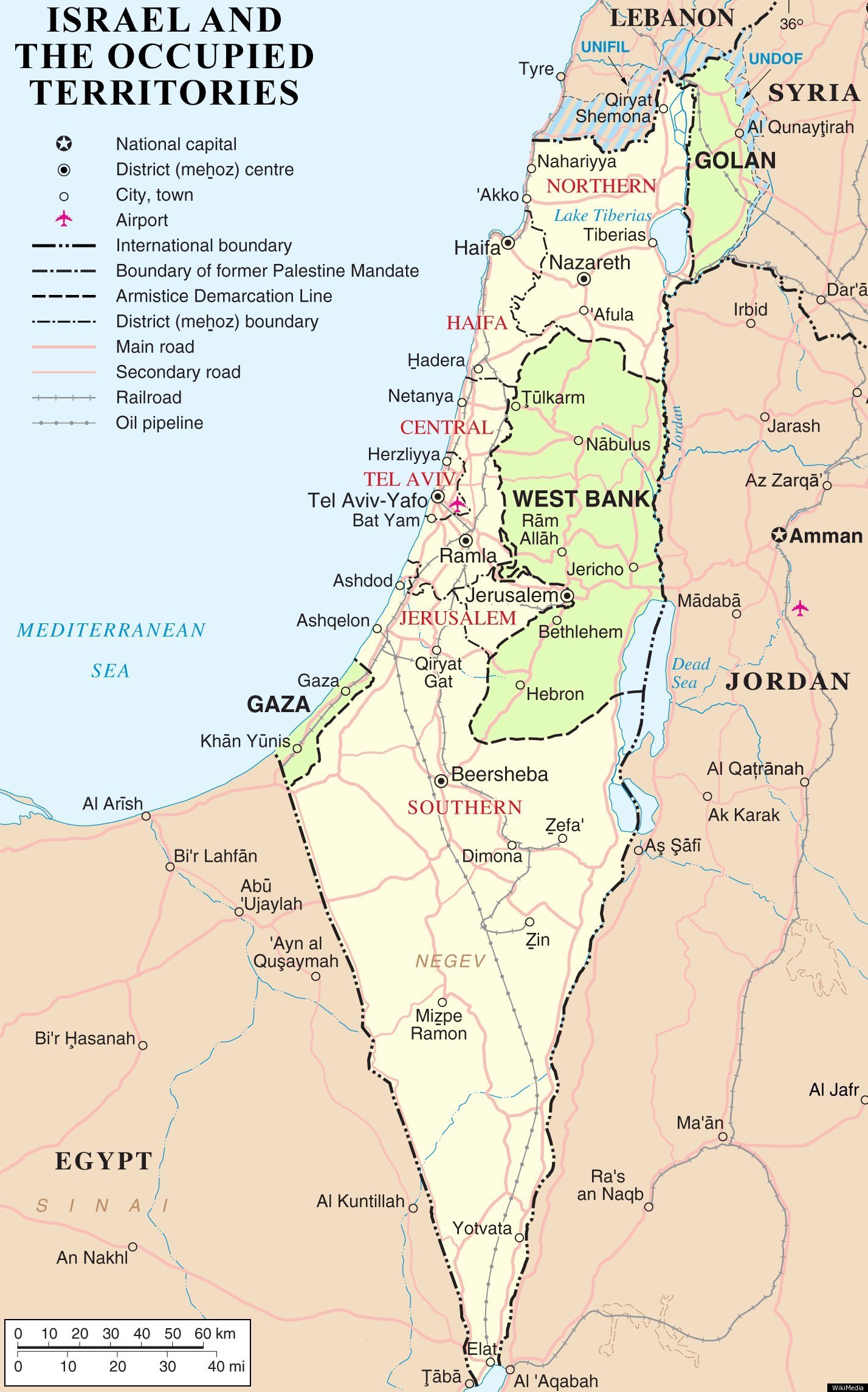
I circled Jerusalem here, and you can see that besides the simple fact that international bodies, like the newly invented United Nations, and various foreign countries did not envision the proposed Jewish state as having Jerusalem as its Capital City, it didn't include Jerusalem in the proposed Jewish country at all. And what it had planned on giving to the Jews as a "country" was even less possible to defend than we ended up controlling in 1949, which created borders known to this very day as "the Green Line," or Auschwitz borders.

Picture credit.
Illegal Jordanian Occupation
pre 1967 Six Days War light beige
credit

The Jewish Israeli diplomatic fight over Jerusalem isn't fifty 50 years old; it's seventy 70 years old and even older when you take pre-state history into account.

And for all those decades the State of Israel has been using the wrong "weapons," the wrong everything. That's because it has wimped out at admitting that our enemy is the antisemitism that has existed from the very beginning of Judaism.

Thursday, February 23, 2017

Finally, Consumer Protection and Warnings for Israeli Citizens Over "Green Line"

Israeli citizens like myself, who live over the "Green Line" in communities that are boycotted by some Israeli businesses are getting some legal protection.

I had to buy my washing machine from a repairman who was
an agent for a company in order to get full service coverage.
To explain how we're effectively second class citizens, it has happened to me and many others, that after choosing to purchase something, a store will suddenly announce:
"We don't deliver to ___"
At best they will give the number of someone who charges a lot more than the distance from store to location would normally cost. And then if the appliance or piece of furniture requires some installation or assembly, we have to pay privately and won't get serviced unless we deliver the malfunctioning appliance/furnishings etc. I have also discovered that the standard service renewal offers haven't been sent to me by many companies. That means that after the required/promised service contract, I have to pay privately. I have no other option. After living in Jerusalem over a decade before our move to Shiloh, I found that to be an unpleasant, unexpected and potentially expensive surprise.

Luckily the Jerusalem furniture where
I bought my couch set a number of years ago
delivered to Shiloh without any problems.
Finally, the Knesset has passed a law that requires businesses to at least warn us in advance.
Knesset passes ban on discrimination against settlers
Now, businesses that do not provide services or ship goods to residents of Jewish settlements in the West Bank will be required to clearly state and display that policy. This makes it different from race, gender, etc. The legislation will prevent a business from deliberately misleading customers about where goods or services will be available.
Businesses that fail to properly warn about their policy — for example with a sign of at least A4 size by the cash register — could be fined up to NIS 10,000 ($2,690).
OK the "advance" is at the checkout counter, but that is still better than nothing. And it must be a properly legible size. The best part is that a business that doesn't comply will be fined.

Many of my neighbors have discovered some excellent appliance shops nearby, in Jewish communities, which offer very competitive prices along with excellent service. We plan on patronizing one of them when we redo our kitchen, Gd willing. We were warned that IKEA doesn't deliver full-service assembly to Shiloh, so I'm not even checking them out. 

A half a century after the 1967 Six Days War, there are many Jewish Israeli citizens living here. The distance isn't great nor is the danger when traveling.

Thursday, October 20, 2016

Historic Fact: It's NOT About "The Settlements!"

שנית עמונה לא תיפול
Sheinit Amona Lo Tipol
Amona Won't Fall A Second Time

All those all over the world, here in Israel and abroad, whether informally chatting over tea, coffee or beer or in hallowed halls of parliaments, think tanks or editorial rooms who keep claiming that "it's the settlements" keeping the "Arab-Israeli conflict," sic continuing are simply full of #$%%!!@#@! to put it mildly.

Modern Shiloh neighborhoods as seen from the Biblical location of the city
Arab violence against Jews, whether they were permanent residents -yes, Jews have always lived in the Holy Land- or just visiting pilgrims, has been a regular occurrence here even before the Zionist Movement began in  1870. And that was almost eighty 80 years before the establishment of the State of Israel in 1948, which was nineteen 19 years before the 1967 Six Days War and subsequent "settlements," which these pseudo-historians claim is the core of the "conflict."

The 1967 Six Days War was the result of the aggression, the unabashed plans voiced very publicly by Egypt, Syria, Iraq and Jordan to destroy the State of Israel. Israel was forced to fight for its very survival and won. According to International Law and all precedent, any land conquered in such a war becomes the legal property of the victor.  So in June, 1967, when the Arab countries effectively surrendered, Israel should have very simply annexed all of the land, the Golan, Jordan Valley, Judea, Samaria and the Sinai including Gaza effectively erasing the temporary "green line" that had been drawn at the 1949 ceasefire when Arab forces which had attacked the newly established State of Israel decided to take a breather and regroup.

Communities like Shiloh, where I live, are not the cause of any so-called "conflict," and "conflict" is a very poor choice of word for the attempted annihilation/holocaust of the Jewish People that has been going on for millenia. Yes, I believe that the Arab terrorism against us here is related to the Nazi Holocaust against European Jewry and the tacit cooperation of the Western World, and prior to that there was the Spanish Inquisition ad the Crusaders among other evil and immoral efforts to destroy the Jewish People.

Friday, February 5, 2016

NY Times Part Right but Totally Distorted

As the saying goes, the most convincing lies have some truth in them. That's a good way of describing this New York Times op-ed called  Who Are the Real Heirs of Zionism?.
The Israeli general and politician Yigal Allon defined Zionism in 1975 as “the national liberation movement of a people exiled from its historic homeland and dispersed among the nations of the world.” Some years later, and more crudely, perhaps, another general and politician, Rehavam Ze’evi, a tough right-winger, said, “Zionism is in essence the Zionism of transfer,” adding, “If transfer is immoral, then all of Zionism is immoral.” (NY Times)
Stockade and Tower Settlement- 
 set up overnight to circumvent
Mandatory regulations.
(Zionism)
Considering that Zionism, the modern return of the Jewish People to the Biblical Land of Israel, led by Jews who claimed not to be religiously observant of Jewish Law, was first "developed" in the late 19th Century in Europe which was undergoing a series of nationalist upheavals, it certainly predated both the Holocaust and the "Green Line." For those idealistic and hardy Jewish pioneers who came to settle The Land, there was no ideological difference between the coastal plain east of Jaffa, Samaria, Judea, the Negev and Galil.
Zionism as an organized movement is generally considered to have been founded by Theodor Herzl in 1897. However, the history of Zionism began earlier and is related to Judaism and Jewish history. The Hovevei Zion, or the Lovers of Zion, were responsible for the creation of 20 new Jewish settlements in Palestine between 1870 and 1897.[1] (Wikipedia)
Wikipedia
The dominant Zionist group was socialist, which evolved into the Leftist Labor Party, but today's Labor ideologues and politicians have nothing at all in common with those brave idealistic pioneers. Their basic ideology has more in common with the notorious "White Paper" which claimed that there wasn't enough room in the barren Mandated Palestine for unlimited Jewish immigration.

It's interesting that the NY Times does consider "the settlement movement" as those who have inherited the mantle of Zionism, but, no surprise, they've also distorted the very essence of Zionism.
“Zionism justified a return to the holy land in terms of universalist values,” said Yaron Ezrahi, a political theorist and emeritus professor at Hebrew University. “The idea was to bring enlightenment and cultural development, to bring universalism to the Middle East. But the settlers are the epitome of particularism, of localism, and they give a bad name to Zionism. If Zionism is a European movement,” he said, “the settlers are colonialism in a post-colonial era. They’ve lost the universal values of Zionism.”
What bothers today's Israeli Left and the New York Times is that today's Zionists aka "the settlers," sic, unlike the pre-state Zionists are no longer following a schizophrenic philosophy which camouflaged their innate belief in Gd and the Bible with secular socialist and Liberal (with a capital "L") philosophies. We unabashedly believe in Gd and see Gd's hand in Modern Jewish/Israeli History.

It's totally clear to me and many others that the very early Zionists were connected to Jewish religion and values, even if they davka desecrated the Sabbath and ate forbidden foods. They were "mehadrin," extremely religious in their love of the Land of Israel. Without a strong belief in Gd and the idea that the Jewish People are the Chosen People, they could never withstood the difficulties of establishing the towns and agricultural settlements. The difficulties were Arab attackers, health problems (diseases that killed so many,) impossibly hard work and logistics impossible to imagine in today's modern world.

The "green line" which, even today, is so fanatically worshipped by most of the world led by Israel's Left, should have been nothing more than a quickly forgotten postscript in history books. Its relevance lasted barely eighteen years, from the 1949 Armistice Agreements until the 1967 Six Days War. In most of the world international borders change without causing even a headline, and Israel's miraculous victory in 1967 should have totally erased those old temporary, dangerous, hard to defend and insecure borders.

Food for thought, Shabbat Shalom, and I'd appreciate your opinions on this post, thanks.

Friday, May 22, 2015

The Faux Morality aka Total Hypocrisy of Those Who Oppose Jewish Life in Judea, Samaria and Jordan Valley

It never ceases to shock me when I hear of Jews, especially, who "will not cross the Green Line" sic, because they, in principle" oppose Jewish Life in any of the Land Israel liberated in the 1967 Six Days War.

I haven't heard of any who won't take the highway between Jerusalem and Tel Aviv, which crosses the "line." And I don't know how many actually are careful to avoid Jerusalem neighborhoods like French Hill, Ramat Eshkol, Ramot and Giloh which all have residents who follow Leftist ideology. And I'm not sure that there are many who also boycott Jerusalem's Old City.


But when it comes to communities like my very own hometown of Shiloh, they act on their "moral principles" which in actuality promote apartheid, pure and simple.

I've never been able to understand how promoting the segregation of Jews, forbidding Jews to live in certain places can be considered moral. During my recent visit to the states, I spoke at the Chabad of Jericho-Syosset, Long Island, and opened my talk by telling them how thrilling it was for me to speak there, because over the years when defending my right to live in Shiloh, I've frequently used the fact that since it's acceptable for Jewish to live in Jericho*, Long Island, why shouldn't Jews be able to live in the original Shiloh, Land of Israel.

These very same people who want to keep Judea, Samaria, Jordan Valley etc judenrein, which was the Nazi plan for Europe and then the world, are outraged when for security reasons Arabs are inspected or kept out of certain places. There are thriving Arab villages near us, but in Arab countries like Jordan, we are not welcome to live.

I find this principle of not wanting Jews to live in our historic homeland (or any place in the world,) inexplicable and totally immoral! It's out and out antisemitism cloaked in faux moral poppycock!

*Today, there is no Jewish community in the original Jericho, which is southeast of Shiloh. During Biblical times, after the Exodus from Egypt and forty years in the wilderness Joshua brought the Jewish People into the Holy-land via Jericho. 

Thursday, December 26, 2013

Remembering... Forty Years Since The Yom Kippur War, A Grave Reminder

It's now forty years plus since the Yom Kippur War, which took place in 1973.  The big lesson from that war should be that all of the political ideological "conceptions," theories, wishful thinking that were believed like a religion by the Israeli government, IDF etc. were dangerously false.

Israeli policy and defense were based on the fallacy that after our great victory in June, 1967, the Arabs wouldn't dare attack us again and that we'd be able to negotiate a real peace treaty by offering generous portions of the land we had inadvertently found ourselves "occupying."

The two-pronged Arab attack on Yom Kippur 1973 was a rude awakening which the Israeli mentality has never fully understood.  The war was a very deadly one.  We, from North American Betar, lost two close friends and still meet every winter by their graves in Mount Herzl Military Cemetery.


Time doesn't stand still for the living.  Grandchildren our dead friends also come to the annual Azkarah, Remembering Ceremony.  They give the dead life.

The only thing that doesn't seem to change is Israeli policy. Our governments are still convinced that that can somehow bribe our enemies into a peace treaty by handing over Land.  The "movers and shakers" haven't progressed since the "battle plans" of the 1967 Six Days War which just concentrated on preserving the status quo of the Auschwitz borders, which were the cease-fire lines of 1949.

For some totally illogical reason, there are Israelis who actually believe that we could survive with a version of those borders.


The family and friends who come to honor the dead every year live all over Israel, from the north to the south to the east to the west, in areas always part of the State of Israel and those liberated in June 1967.  Every year the IDF soldiers assigned to our Azkara are impressed and amazed by the fact that we still get together every single year.  It doesn't matter how busy we are, what's going on in our lives, we make every effort to visit the dead and then sit together catching up and remembering.

It saddens and frightens us that most Israelis refuse to accept reality.  We met as teenagers in Betar, the Revisionist Jabotinsky zionist youth movement.  We learned young that we can't trust the mainstream zionist leadership.  Nothing is new.

Peace won't come from American brokered negotiations, nor giving Arab terrorists more precious land. The Arabs just want us dead, and then they will destroy the State of Israel and defile the cemeteries. The world will just look on and add exhibits to their holocaust museums.  G-d forbid...

Wednesday, July 31, 2013

"Peace Agreement" versus Israeli Security- It's Not About Settlements

Way back when, pre-Disengagement I disagreed with what most everyone was saying about the dangers.  I even made a speech at an anti-Disengagement demonstration in Manhattan. My basic premise was that it wasn't about "displacing" a few thousand wonderful Jewish families.  The dangers were to the very security of the country and establishing a precedent that could G-d forbid be used in Judea and Samaria.  Unfortunately, I was 100% on target, unlike all of the official protest movements and the YESHA Council.

Now again, I find it important to stress that giving Arabs sovereignty over Judea and Samaria, whether the entire area or just sections endangers the entire State of Israel.  Quite a number of years ago, I was in a tremp with a neighbor, Yossi Apter, who then also picked up a soldier.  In those days soldiers were permitted to tremp.  Yossi asked him what he was doing here, and he said:
"I'm guarding the yishuvim, settlements."
"No you're not" said Yossi.  "You're protecting Tel Aviv.  If Israel doesn't hold onto Judea and Samaria, then Tel Aviv is in danger."

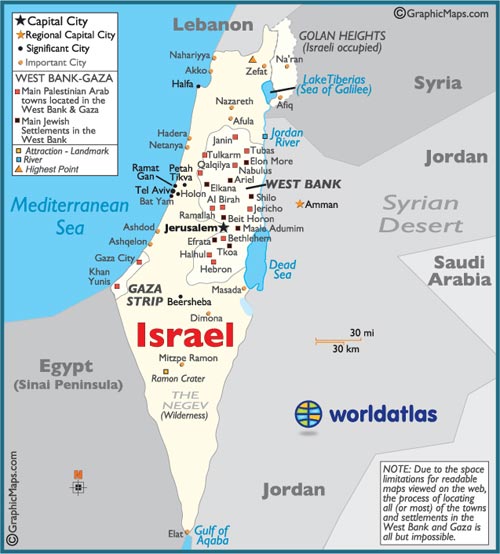
Take a look at the map.


Israel is a very tiny country.  Besides the very simple basic fact that NO OTHER COUNTRY HAS EVER GIVEN AWAY LAND LIBERATED IN A DEFENSIVE WAR TO AN ENEMY THAT HAS SWORN TO DESTROY IT, it's clear that without Judea and Samaria most of the State of Israel is totally vulnerable to attack.

There is no logical nor historic nor moral reason for Israel to give the Arabs anything at all.
Nearly five years ago, Prime Minister Binyamin Netanyahu accepted the Palestinian demand of a state with security conditions. Israel has also agreed to release more than 100 additional incarcerated Palestinian terrorists in stages.
Israeli housing starts are frozen in Jerusalem and Judea and Samaria and, according to Palestinian officials, Abbas has received a side letter or an oral guarantee at a minimum from the United States assuring the Palestinians that the disputed pre-war, June 4, 1967, lines would be the baseline for final-status negotiations, as reported by the Associated Press on July 21.
Virtually every Israeli government since 1967 has determined the pre-war 1967 line to be indefensible, while former Oslo negotiators such as former ambassador and legal adviser to the Foreign Ministry Alan Baker have noted that the 1967 lines constitute a legal fiction and that “no such borders ever existed.” (Dan Diker, Jerusalem Post)


The "green line" has no real legality.  It was a ceasefire line that existed barely eighteen years and didn't protect Israel at all.  Israel was attacked during that time on all fronts, from Jordan, Syria and Egypt.  In May, 1967, Syria, Egypt and Jordan began threatening Israel, demanded that United Nations Peacekeeping forces leave their posts and prepared for war.  Thank G-d, at that time, Israel had no foreign allies, just the Jewish People.  We prayed, and the Israeli Government sent the IDF into action to defend the country.  That's how we liberated the Golan, Judea, Samaria, Jordan Valley, Gaza and the Sinai.

We can't easily cancel the withdrawals from the Sinai and Gaza, but we must immediately cease the begging for peace and the offering of more Land!  If we don't, then the State of Israel can't survive.  LOOK AT THE MAP!

Thursday, May 22, 2008

The Golan Heights-- Background

Unfortunately, too few people remember what life was really like in pre-1967 Six Days War Israel. Besides the difficult poverty, making life here much more difficult and technologically primitive than most people, today, can ever imagine, there was constant terrorism.

The 1949 ceasefire lines put most Israelis in continuous danger. Most people were working so hard just to survive that they didn't question Israel's moral right to exist. Today's affluent Left wing has fermented a dangerous brew, and that's what has propelled Olmert's government into more and more dangerous negotiations. Now the Golan is being offered to Syria, a country not shy in claiming its dream to see Israel as a footnote in history.

Here's some background about the crucial importance of the Golan for Israel's security:


The Man Who Convinced Eshkol to Take the Golan
by David Bedein,


The course of history can be changed by the determination of one man who stands up for what he believes in when he is listened to by people who are in a position of power.

The initiative to demand that Israel take the Golan Heights came from not from real estate-seeking settlers who wanted to move to the Golan, but rather from the residents of the Upper Galilee, or, to put it better, directly from the regional Mayor of the Upper Galilee, Yaakov (Yankela) Eshkoli, the man who led the delegation of Upper Galilee residents to lobby Israeli Prime Minister Levi Eshkol and the Israeli government on the fourth night of the Six Day War.

Eshkoli's mission: to convince Eshkol to issue an order to the Israel Defence Forces Northern regional command to take the Golan Heights and to remove the Syrian threat, once and for all, from over the heads of the Galilee settlements.


Eshkoli, now 88, was elected four times to be the regional mayor of the Galilee, and served in his position from 1955-1971

Speaking with remarkable resilience and a clear memory after 20 years of severe heart disease, the aging Eshkoli, with his ninety year old wife Yaffa at his side, cannot keep repeating how pleased he is that he has lived to tell his story, while talks with Syria get under way and while the future of the Golan is indeed on the agenda.

"13 years ago I had a heart attack and the doctors declared me to be clinically dead. I guess I recovered so that I could tell my story today", Eshkoli says, with a wink and a twinkle in his eye, when I met him on his porch, on Kibbutz Cfar Giladi.


Cfar Giladi is one of the oldest Galilee settlements, located just north of Kiryat Shmoneh and sandwiched in between Lebanon and the Golan Heights, where he and Yaffa, now 90 years old, have been kibbutz members since 1932.

Eshkoli says that he is always eager to relate the role that he played in convincing the Israeli government to take the Golan in the midst of the 1967 war.

As Eshkoli tells it, by the fourth day of the 1967 war, it was clear that Israel had delivered a solid defeat to Jordan and Egypt.

That left Syria, which had been raining a steady stream of rockets into the Hula Valley below, leaving the residents of 31 settlements in the Upper Galilee region in Eshkoli's jurisdiction to spend those glorious days of 1967 in deep underground bunkers, glued to their transistor radios.

Eshkoli recalls how he placed constant calls into Israeli Deputy Prime Minister Yigal Allon from his underground bunker on the Kibbutz to ask to see Levi Eshkol, then Israel's prime minister, to demand action on the Syrian front.

Allon, the 1948 war hero who with liberated the Galilee, promised to get Eshkoli called him on the fourth day of the war with the good news that Eshkoli could meet Eshkol and the Israeli cabinet that evening, warning him that at least one senior Israeli cabinet minister opposed any move towards the Golan Heights . . . .

Leaving his kibbutz in an army jeep , picking up Kibbutz leaders from other settlements in the region, while every kibbutz member was ordered into the shelters because of the continuing Syrian artillery bombardment, Eshkoli remembers that he had the feeling that his Hula valley was burning while the rest of the country was dancing in the streets

Eshkoli speaks of his descending the steps into the underground headquarters of the Israeli government in Tel Aviv as if it happened last night. Eshkoli gets tears in his eyes when he describes the hug that Levi Eshkol gave him when he showed up. Eshkoli that his full delegation of four be allowed to enter the cabinet meeting, and he recalls the Bible that he was asked to swear on that any matter of security that he would hear would be kept in strictest confidence.

Eshkoli was given five minutes to speak. "The longest five minutes in my life", Eshkoli remembers. His appeal was simple and clear, when he reminded Eshkol that he and every Israeli leader who had ever come to visit him in the Galilee after Syrian rocket attacks had promised them that if there would ever be another war, that they would use that opportunity to remove the Syrian threat, once and for all.

Eshkoli reports that the one Israeli minister to oppose the idea: Moshe Dayan, the former Israeli commander in chief who had just been appointed to be Defence minister. Dayan had given the veto to his northern regional commander, "Dado" Elazar, whom he forbid to attack Syria on the Golan, "lest this cost us 30,000 dead and risk a war with the Soviet Union", which had just pushed through a cease-fire in the UN Security Council. Dayan the war hero from the 1956 war with tremendous popular following, also made a great impression on the cabinet.

Eshkoli recalls that he then thought to himself: "Will I be responsible for world war", and then said that " I could only think of my wife and the children of the kibbutz who at that moment were in the shelters". It was then that Eshkoli made a threat, which he says to this day that he meant with all his heart, which was that if the IDF does not remove the Syrians from the Golan then he would recommend that all Kibbutzim pack their bags and leave, and that the people of Kiryat Shmoneh would follow. Silence followed Eshkoli's emotional appeal to the Israeli cabinet.

As Eshkoli turned and began to leave the meeting, Israeli Prime Minister Levi Eshkol grabbed his hand and proclaimed that "The words of Eshkoli have entered the heart of Levi Eshkol, and they will play a crucial role in what we decide to do on the Golan Heights".

Eshkoli could not know when he left the government meeting, heading back north, whether he had succeeded in his mission. Would his words hold greater weight than Moshe Dayan?

Heading back to Kfar Giladi, Eshkoli stopped off at the bunker of the IDF Northern regional command. By then it was 5AM. "Dado" was slumped over his desk, next to a bottle of half-empty scotch .

Eshkoli reported to "Dado" what had happened at the government meeting. And while they were talking, "Dado" received a call from the Israel Defence Ministry. Moshe Dayan's resonant voice was on the line with an order - "Ascend the Golan and Succeed" were Dayan's words, and they were repeated on the 6AM Voice of Israel radio newsreel.

"Dado" loudly said to Eshkoli that he had succeeded with Dayan where he, the IDF northern regional commander had not.

Indeed, Dayan's vote in the government was the lone voice in the government to vote against the Golan attack . . . .

Dayan never forgave Eshkoli for besting him at the government meeting. Eshkoli shows me a yellowing news interview from 1976 with Moshe Dayan with the Israeli daily newspaper Yediot Aharonot, where Moshe Dayan could only recall Eshkoli and his delegation with anger and resentment, characterizing them as "Dado"'s agents, claiming that , anyway, "the provocation's of the Galilee farmers and fishermen in no-man's land were the cause of the Syrian shellings".

Eshkoli looks at the picture of Moshe Dayan and starts to yell at him "Right - All of my 31 communities provoked the Syrians from their shelters. Our provocation against the Syrians is that we live and prosper here in the Galilee, which the Syrians see as a province of their country".

Asked about the current negotiations that might bring the Syrians back to the Golan Heights that face down on his kibbutz, Eshkoli could only raise a trembling hand and point to the hills and say that to "bring back the Syrians would be suicide for us".

Eshkoli's successor as regional mayor of the Upper Galilee region, fellow Kfar Giladi member Aharon Valenci, is much more sanguine in his attitude to the possibility of territorial compromise on the Golan, saying that he trusts Israeli Prime Minister Ehud Barak and that if the Syrians are serious about peace, then the issue of the Golan would not be as important as it once was, noting that "99%" of his kibbutz were supportive of the peace process with Syria. Valanci said, however, that he will wait to see what the Syrians convey to their own people in their own media.

However, another prominent Galilee kibbutz leader, Muki Tzur, from Ein Gev, on the shores of the Sea of the Galilee and meters away from the Golan Heights and what might again be Syria, writes an interview with KIBBUTZ, the magazine of the Kibbutz movement, that it was premature to take a position on the peace process.

Tzur, the 1967 author of the best selling book known as the Seventh Day: Conversations with Fighters from the Six Day War, writes in his article that Jewish and Israeli history has taught us that any peace process with Israel's adversaries will be long, hard and complex, and that no decision can be made under the pressure of an immediate desire for peace. The price of a mistake in the peace process in the North would be guns in place once again on the Golan, trained on the 31 settlements of the Hula Valley in Israel's lush Upper Galilee region.

Yankela Eshkoli stood up to Moshe Dayan.

That is why the guns in the Golan were removed, and that is why 33 Israeli settlements replaced 15 Syrian army camps on the Golan Heights.