Hamas War

Showing posts with label public transportation. Show all posts

Monday, April 13, 2026

War Musings #73 The Con of Ceasefire or The Calm Before The Storm


In most of Israel, there has been quiet since the U.S. brokered "ceasefire" with the terror state Iran. Schools and stores have reopened, public transportation has returned to its previous schedules, neighborhood shelters are getting cleared and cleaned... but behind the scenes there's a different conversation. 

Remember that a ceasefire leaves both sides viable. The weaker or "evil" one may be "damaged," but it's not dead. It can and usually will rise up again, sometimes much stronger than ever. It's not a victory/defeat. It's a postponement of the inevitable, especially when one of the parties swears/promises/aims to destroy the other one, politicians, military and innocent civilians. 

In conversations between friends, I keep hearing:

"We just have a few days, since the war will resume..."

The following is what I written in my nightly "Gnite" post on Facebook. What do you think? Please reply in the comments, and share if you agree, thanks.

Gnite... confusing, frightening times. The Bibi government is trying to fool the people, saying "back to regular life, schools as usual, public transportation on regular schedule... no war..." But there isn't peace. Israelis in the north of the country are being attacked. Our enemies are obviously re-arming and planning their next attacks... but in Israel people have been told to take their mattresses out of the shelters, so activities can return. My mosaics class takes place in a neighborhood shelter, which is officially the senior citizen club house, or moadon as it's called in Hebrew. Today we discovered that some of our tables are missing, and luckily we lock up the equipment we use...
Iran doesn't want peace, and no "deal" will change its mind. Did the Allies make a "deal" with Hitler? Trump doesn't understand the mentality of war and terrorism. He's a businessman, not a historian-military man. The only American politicians worse are the Democrats. And here in Israel... we have we have weak bombastic Bibi. Similar to the situation in the states, the only politicians who are worse are in the opposition. It's time for some brave intelligent people to stand up and tell the truth. We've had almost annual wars since Bibi became Prime Minister. Each time, they quiet down and Bibi says: "They'll never try that again. We showed them... " but they do attack again and again and again... That last major attack on October 7, 2023 was a doozy for sure. Pictures and the terrorists' own selfies showed that they are civilians, the same faux "innocent civilians" that Bibi warns to leave their houses, so he can waste our bullets. Bibi calls them "innocent civilians," but they're the ones who raped and murdered our people, our truly innocent people two and a half years ago.
OK, I had to vent... Bedtime, so Gd willing a better tomorrow.

Saturday, August 28, 2021

Israeli Public Transportation "Almost Free" for Senior Citizens


We've never had a car. As an American suburban teen, I took Drivers Ed, got my driving license, etc, but my husband didn't. I used to drive my parents' cars when needed.

We made aliyah (moved to Israel) soon after our wedding in 1970, at a time when private cars there were still very rare. In those days the roads were awful and driving culture even worse. Most drivers were "first generation," meaning the first in their families to ever drive or own a car. Having never really enjoyed driving, I was terrified to compete with them on the roads. 

As years went on, I stopped renewing my American Drivers License and didn't bother with an Israeli one. We never made a lot of money, so the idea of having to budget car expenses, especially for one large enough for a family of seven, never appealed to us either. And as everyone can guess, one car wouldn't have been enough.

We've always somehow managed with public transportation. On rare occasions, we paid people to drive us, which cost less than owning a car. 

Now we're senior citizens, and not only has public transportation improved, but it's half price for us. One of the really great improvements is that there are free transfers on city buses within a certain time span and the option of daily, weekly and monthly passes. You just need a RavKav bus pass. There are personal ones which automatically give us our discount and anonymous ones which can be used by anyone including tourists, but they are only full price trips. 


Since we live outside of the big cities, I generally buy an unlimited day pass. For NS13, which is about $4-. If I have to go to Ariel I need to add another district, so it cost NS16- less than $5. This includes buses, lightrail and trains within the district.

Recently I heard of another way of paying which ends up less for short distances. You use an app on the phone. But since my phone doesn't have enough memory I'll have to wait until I get a new phone.

Life in Israel has its advantages for sure, especially for senior citizens.

Tuesday, December 18, 2018

Is This Art?


It could be. Maybe it's a glass mosaic aka stained glass? There's something haunting about it, like a Vincent Van Gogh painting when his demons were overpowering him.

Well, the truth is that the "technique" is related to "demons," but not the imaginary kind, not the kind of a schizophrenic, chemically imbalanced mind.

Yesterday, when I got on the bus home from Sha'ar Binyamin burdened with heavy shopping bags, the closest unoccupied seat was by a cracked window. I try not to sit by cracked windows. The buses that ply our routes have bulletproof windows. They are also strong enough to stay whole/unbroken if a rock is thrown at it. To be accurate, that's true until you see cracks like this one had.

bus window cracked by Arab terrorists attack

The recent increase in Arab terror attacks, davka, on the road we travel, has killed, injured and caused damage. Thank Gd yesterday's trip to and from Jerusalem was uneventful, but we can never take an easy and safe trip for granted.

Friday, November 30, 2018

Learning to be Late and Accepting Blessings

For as long as I've known how to tell time and been old enough to have control over "arrivals," I've been fixated and obsessive with being not just "on time," but early. I've never seen a stated "time to start" as an approximation. For me, even as a little girl going to a birthday party, I was horrified, totally mortified at the idea that I may be late.

No matter what the occasion, I'd treat it like catching a train or plane or making sure I made it to the theater well before the curtain was to go up.

When I got older, I learned that, at least here in Israel, times stated for wedding invitations were always much earlier than we needed to be there. After arriving too many times while the caterer was still having the tables set up, we learned how much time we had to add to the "invitation time." Here in Shiloh, it took a few years to learn that events are on what they call "Bnai Akiva time," which is nothing like the exact scheduling in NCSY or the LIRR.

Since we don't have a car and not only can't one rely on the bus schedule, besides the fact that sometimes there aren't buses from Shiloh to our destinations, I've learned to accurately plan my departures for all eventualities. But yesterday afternoon/last night, even I failed.

I needed to get to a "surprise party" in Kfar Saba by 6:30pm. With the help of google maps, I discovered that with bus connections at both the Yarkon Junction and Morasha, it would be very doable. There is even a 5pm bus to Kfar Saba from Ariel, though is goes through Rosh Ha'ayin. My plan was to give myself two and a half hours, which should have made me about a half hour early, at the latest.

Man plans and Gd laughs, as they say. At 3pm, I got a message from my kids that there had been a horrific fatal accident "outside of Ariel. The roads are blocked in both directions." Click here for report and photos.
"Maybe you should meet one of us in Jerusalem, and we'll take you." My kids suggested.
Considering that going via Jerusalem also would include traffic jams and double the distance, I declined.
"The Trans-Samaria Highway is wide road. No doubt it will be cleared by the time I get there."
To be honest, I was wrong.

At first it seemed like "business as usual" in Ariel, lots of buses and traffic near the university. I even declined to get on a Petach Tikva bus, because it wasn't going to Morasha, which would give me the quickest and best public transportation to Kfar Saba. Since I couldn't find the bus stop to the direct bus, I waited for the 386, which not only goes to Morasha, but it doesn't do the "grand tour" of Ariel. It's a great bus, but although the electric sign kept saying it was coming, the bus never showed, nor did any other for at least a half an hour. Finally, in desperation I took the next bus to arrive, which was a 296. The driver said that he goes to Yarkon but not Morasha. He warned us that the road was still blocked, and he may need to make a detour.

Actually, even with all the delays, I still had a good chance of being on time. That's how much "extra" time I had allocated to my trip.

The driver was optimistic and even said that it looked like the road had opened. But as we got a few kilometers from the accident scene, all we could see was the long line of lights of cars stuck in traffic. Yes, it was very dark by then. I began to realize that I'd probably be late and arrive long after the joyous "surprise."

When we passed the almost totally burnt up bus, all that remained was the spooky skeleton, I became very grateful for the fact that I was on a functioning bus, sitting comfortably and safely. Gd willing I'd arrive safe and sound, albeit a bit late. It wasn't the end of the world.

At the Yarkon Junction, I quickly caught a bus to Kfar Saba, and one of my kids picked me up to take me the rest of the way. I was glad, because even with the help of Google maps, I'd have trouble finding the house in the dark.

Yes, we walked in after the guest of honor, but it was before the "program." We had a wonderful joyous time. It was no tragedy to be late. It certainly wasn't the end of the world. Everyone was happy to see me and appreciated the efforts I make to attend all events. B"H, going home was easy; we had a ride with one of our kids, who would anyhow have passed Shiloh on the way home.

It's so important to remember to say תפילת הדרך Tefilat Haderech, the Traveler's Prayer when you start a trip. It may not guarantee a safe journey, but it reminds us that all journeys have their potential dangers, and we must thank Gd for our safety.

Waiting for rides/tremps and buses yesterday, Eli Junction and the Ariel University bus stop

Friday, November 23, 2018

Arabs on Ariel Buses, Another Problem

In the past I've written about the ongoing situation in which the buses from the Petach Tikva, Tzomet Yarkon Junction area going to Ariel are overloaded with Arabs to the extent in which they skip bus stops leaving Jewish passengers stranded. I wrote about it here, here and here.

Yesterday afternoon I was there again in the afternoon and needed a bus to Ariel. One bus passed without stopping, but soon afterwards another one came. I was able to board the bus and had to walk until close to the back of the bus until I found a seat next to a female IDF soldier just across from the rear door.

I relaxed, used the cellphone Siddur app to pray the Mincha afternoon prayer and then didn't pay much attention to what was happening on the bus. I heard someone ask the driver to open the rear-door, and then a bit later I someone pressing on my right shoulder and arm.

The bus had somehow filled with Arabs. There must have been at least thirty 30 men crowded into the narrow aisle, so those of us sitting in aisle seats kept getting pushed and shoved. I found myself crowding into the space of the young woman sitting next to me, while simultaneously pushing the Arabs off of me. I apologized to the woman by mentioning that the driver isn't allowed by law to fill the aisle. She replied that an Inspector just boarded.

The Inspector asked to see our tickets, and I could hear and see him confirm that many of those Arabs did not have tickets. Apparently when I was busy with my eyes on my screen Arabs had boarded via the rear door without paying. When he got to me, I mentioned the unbearable crowding, and he replied that by law it is forbidden to have more than I can't remember if he said eight or ten people standing in the aisle. BTW the bus driver was an Arab, too.

I don't know what the procedure is in other places, but here in Israel, if an Inspector discovers that a passenger hasn't paid, the driver is fined. When the inspector got off, I could hear (and not understand) very loud talking in Arabic. That is very rare. Generally the Arabs are extremely quiet on the Israeli buses.

Thank Gd they are starting to send Inspectors on the buses. Never dull...

While waiting for a bus at the Yarkon Junction, I spotted this plane coming from the nearby Ben Gurion International Airport

Monday, October 22, 2018

Who Should Replace Avi Roeh as Head of Binyamin Regional Council?

There will be local elections all over Israel next week. That includes the Regional Council of Binyamin (Benjamin,) the local council of Gush Shiloh Bloc and our representative to the Binyamin Forum (parliament.) Yesterday I wrote that I'm supporting עמק שילה- ועד מקומי Emek Shiloh-Vaad Mikomi, vote עמ list for our local council,  and today I'll write about the top position.

Last night I attended a chug bayit, parlour meeting to meet, listen to and ask questions of Shiloh Adler, one of the two candidates hoping to replace Avi Roeh as head of the Binyamin Regional Council.  The meeting was very well attended, which doesn't show up well in the photos because of where I sat. Men and lots of women were there, too. Most were of the younger generation with children in school and still having babies. There were a few around my age. I was the oldest, but not the most veteran in Shiloh.


By process of elimination, I had quickly decided that I'd vote for Shiloh Adler even before hearing anything about him, but I needed to make sure I wasn't making a big mistake. The reason why I didn't want to vote for Yisrael Ganz is simply because I'm disgusted at how things are being done by the Binyamin Regional Council, and Ganz is one of the present hierarchy there.

Our public transportation is awful. Buses are unreliable, schedule problematic, routes, not enough or varied etc. A couple of years ago, the Binyamin Regional Council replaced very good wooden bus stops (shelters) that had windows  and replaced them with badly designed and constructed metal ones that neither protect us from the elements nor allow us to see an approaching bus nor let the driver see that we're waiting inside. And then right before elections, there was extra money, so they decided (like many other municipalities) to give us new sidewalks which almost cancelled our bus service. That's because the so-called planners never bothered to check government regulations for road width. They also destroyed very safe and sturdy safety rails on the staired paths and replaced them with cheap, thin rickety ones, which not only are already falling apart, but they are falling out of their sockets. While working on these "upgrades," as the Mateh Binyamin, the regional council calls them, they broke my main water pipe and damaged the garden wall. And there are other problems. So, for me, it was an easy and obvious choice not to vote for anyone connected to the present administration.

But I'm too much a political pundit and realist to blindly vote for Shiloh Adler. I had to meet him. That's why I went to the meeting last night. A few English-speaker friends had asked me to send a report about the meeting. The following is what I wrote/emailed, typos and all:
There was a nice group at the meeting, mostly young people from the middle and down the hill.
Adler came well prepared, with a staff/crew of impressive people, who also spoke.
What bothers him is that nobody ever says they're from Binyamin. After all these years, and despite the large size and population, it never has made people feel its presence. That bothers him, and he'd like to fix it.
He asked for questions. I had to reduce what I had planned to the minimum, so I mentioned public transportation and the awful roads. I stressed that we can't get to most of the Binyamin yishuvim easily, even Kochav Hashachar which is close as the crow flies. And Places like Talmon are near impossible.
I also complained that the moetza put all the offices in Psagot, which is out of the way and now in Sha'ar Binyamin. I mentioned that I consider Shiloh as having moved to Petach Tikvah and in my combination bus/tremp, I can get to Tzomet Yarkon more quickly than Jerusalem.
Adler seems to understand a lot about the financial potential, business etc.
Later he replied to my question. He has researched (his staff no doubt) the public transportation in other areas and agrees that ours is the worst.
I came up with someone who says that Ganz says many of the same things, but Ganz didn't come with a strong backup team. And although he has been with the moetza for a number of years, he never really succeeded in fixing anything and moving stuff.
I saw at least one person from the Emek Shiloh list. Moshe Batish was there, too, and he's running for the Moetza council seat. 
Before previous moetza (regional council) elections, I had gone to a number of "meet the candidate" events, and I must say that Adler's was the best presentation I've ever experienced. Not only did he take notes as we spoke, he tried to answer some of our questions after all questions had been asked, including mine. Then when he rushed off to his next meeting of the evening, his crew (cabinet) stayed to further answer our questions. I was impressed that one even buttonholed me for more information.

I have no doubt that we need new leadership in Mateh Binyamin. The only one offering that is Shiloh Adler. The icing on the cake is that he seems very competent and has surrounded himself with a good team.

Wednesday, September 5, 2018

Gd is Great! Such a Siyate d'Shamya Shopping Trip

Gd gifts us with miracles when we least expect them, and we really ought to open our eyes to Gd's gifts even among a mundane day.

We've had all sorts of intermittent internet and wifi disruptions for quite awhile. We figured that it's "normal" out in the sticks. But the other night the service just didn't return. Before Shabbat my husband had complained that his computer, a laptop in the boys' old bedroom, now his den, wasn't working. And after Shabbat, I noticed that my phone didn't show the wifi icon. So I pressed, pulled in and out the usual buttons and wires on the router, and things just got worse. No internet ether. So we called Bezeq.

After a couple of hours, remote control adjustments and multiple phone technicians, a lovely female tech told me that the chronic problems were caused by having the wrong type of cord from phone to wall, which needs a "box" instead of directly plugging it in. I needed a "rosh gadol" (large head) rather than the "Americai'i rosh katan" (small head, American.) With the right cord, I wouldn't need the box. She assured me that I could buy it in all sorts of stores besides the Bezeq store in Jerusalem.

At least she got the internet and wifi working again. Since I understood exactly what was needed, I decided to buy the cord and figured I'd find it in the humongous they have everything hardware, building supply shop in the local industrial zone. So yesterday late morning I braved the strong summer sun and heat to go down to shop for it. Nu, they didn't have it.

A bit later in the afternoon, I was getting antsy after being home so much and knowing that I still needed the cord and a new watch, too. There was no way I could reasonably get through Rosh Hashanah without a functioning watch, since we also don't have a wall clock. It's one of those things we still have to buy post-new kitchen. I decided to take a "quick trip" to Jerusalem to shop. Both the Bezeq store and Center 1 where I was hoping to find a watch are easy to get to on the bus near a bus stop. Of course, we never know if the bus will actually arrive, but that's another issue entirely.

Amazingly the bus showed and pretty much on time, but as we approached Sha'ar Binyamin I received notification that there had been an accident near Adam, and we could see traffic backed up. As the bus went into Shaar Binyamin I debated until the very last second about whether or not to get off and try shopping there, but I knew that they didn't have the stores I needed, so I prayed that I'd get to Jerusalem without too much delay. It was clocked at a forty minute delay, but at least Yirmiyahu Street was empty.
I ran to the Bezeq store, and the guard had mercy on me, even though as he said:
"It closes in one second."
I took a number and waited. Yes, I was the very last customer. Even though the clerk wasn't sure she had the cord I needed she checked and found one. It was only NS15, just a bit more than my roundtrip bus fare. I paid and then went to search for a watch in nearby Center 1.

In previous visits to Center 1 I had noticed a new watch stand, which had very thrifty prices, but suddenly it was gone. The closest stand I found with watches, better than the jewelry store or low quality discount store, had watches starting at NS100. I took a quick look and entered the main part of Center 1. There was an even smaller selection there, and the NS100 watches looked like rejects and had no guarantee.

I returned to the first watch stand and asked about guarantees:
"One year," the salesgirl replied.
First I took a look at the NS100 watches. There were two of the design I liked but not the colors. I tried a few on and ended up spending a bit more than I had planned, but the price was OK.

Now to get home, which is always a challenge, since so many buses are inexplicably cancelled sans notification.

After checking the efobus app and discovering that there wouldn't be a bus very soon, I got to the closest bus stop and grabbed the first bus to Hizme, the cityline. On the way, I checked efobus again, and it said that the Shiloh bus was actually on its way and would come in 15 minutes. Just as I stepped off the bus in Hizme, a car pulled up, my daughter. That was a super treat; she lives on the way to Shiloh. So I decided to catch my bus at her stop. A minute after I got off at that bus stop a car passed signalling to the right, in the direction of Shiloh. I quickly recognized my neighbor, signalled back and began chasing his car. B"H, thank Gd he noticed me stopped, and I had a ride straight to my door.

I thank Gd for His Mercy and Blessings
Yesterday's shopping trip was a gift from Gd Almighty for sure.

Tuesday, August 14, 2018

Celebrating 37 Years in Shiloh, Memories of Day 1

On the Jewish Calendar yesterday was our "move to Shiloh" anniversary, the 2nd of Ellul. On the goyish calendar we moved on September 1, 1981. Our daughters came by bus the day before, so they'd be here for the opening of the school year.

When the girls, then aged ten 10, eight 8 and five 5, were sent on the bus alone by my husband, we didn't think it a strange thing to do. Never having owned a car, the girls were used to traveling by bus. In those days, private cars were rare, and the other passengers were mostly commuters going home to Beit El and Shiloh. I don't think there were any other stops on the route. The bus went through Ramalla; this predated today's Route 60. Most men, and a few women, had pistols for self-defense.

The girls slept at the neighbors who had been assigned as our "mishpacha ma'ametzet," adoptive family, who were responsible for helping us settle into our new life in Shiloh. I had packed the girls up with what they needed for the first day of school, 5th Grade, 3rd Grade and Kindergarten. They were all going to study in different places.

It was easiest for our youngest daughter, whose pre-school was located near where they were staying, though she didn't know any of the other children. Our eldest had to travel to Ofra for school. There was a van that took her and the other children 4th Grade and up every morning and then back to Shiloh at the end of the school day. She never missed it; there was no other way to get to and from school. Our second daughter was privileged to be able to study in Shiloh. The community had decided to open an elementary school to make Shiloh a more attractive and easier place to live in. Luckily, it had been decided to have a 3rd Grade class, and there were six children in it on September 1st, boys and girls together. She was the oldest girl. There were four children in the 2th Grade and eight in the 1st Grade. Over the next couple of months, one family left, a few moved to Shiloh, and the number of children in the school rose to about twenty.

The new school was in three empty prefabricated houses in the new neighborhood where we live to this day. Then it was brand new without a paved road, sidewalks etc. Forty small cement houses had been placed on the barren hilltop, over a mile from Tel Shiloh, where everyone else lived. I don't think there were a dozen families when our moving van, with my husband in it, pulled up that day. I came with our newborn baby son by bus a few hours later. Of course, the bus didn't come up the hill; Egged only travels on paved roads. I had to go up in a ride.

Not all of the houses had been hooked up to the electric generator, water and sewer. That had limited our choice of which to choose. During the first few days in our house, even though the toilets worked, we had to wash our hands in the kitchen sink.

Despite the obvious difficulties, I really enjoyed being part of the great Zionist experience/adventure. Our neighborhood/community became very close, and we were helped a lot by the more veteran families "down the hill."  Even for a writer like myself, it's hard to clearly verbalize what attracted me to Shiloh, but I've never had a doubt that Shiloh is the right place for us. I'd say that the best decision I/we ever made was to make aliyah and the second best was to move to Shiloh.

Ohel Shiloh Elementary School 3rd Grade girls, spring 1982

Monday, May 14, 2018

No Room on Ariel Buses

Yesterday afternoon I was pretty lucky. Only one overfull bus bypassed/skipped the Tzomet Yarkon (Junction) as I waited for a bus to Ariel. I noticed from the computerized bus sign earlier in the day and my public transportation phone app that buses are more frequent than previously, but they were still full of Arab workers at 4pm. Besides the Israeli public transportation, I saw Arab vans picking up Arabs at the bus stop.

After another few minutes of waiting, a #286 stopped to let off passengers. I could see that there were some passengers standing, but I went to the driver's door anyhow. She, yes a female bus driver, let me in. I paid and was about to sit on the stairs when I noticed a young woman signalling me that she was giving me her seat. She and an older Arab got up for me. I got in, and then they each insisted that the other sit with me. In the end, the young woman did.

Looking around I didn't see any other females, just us and the driver. And I only heard Arabic being spoken. The bus was packed, and the driver skipped all the stops, since nobody rang to get off. It's against regulations to have passengers standing in the aisle.


But at the Oranit/Elkana Junction stop, a couple of young Jewish women got off from further back. And then a few stops later, the bus pretty much emptied out at the last stop before Ariel. Only a handful of us remained on it as it entered Ariel.

I got off at Ariel University and then waited for a ride home to Shiloh. B"H, three rides later I got home safe, sound and relatively quickly.

Monday, April 16, 2018

Lesson in "Midot," Proper Manners, 2 Bus Stories


מפני שיבה תקום
MIPNEI SEIVA TAKUM
Before an old person, get up

Simply stated, that means that one must give one's seat to the elderly or infirm. This can be in any place, a bus, train or waiting room. It can also be at home or at an event, or even when piling into the family car. It's important to train/educate one's child from the youngest age to be aware of others and give an older or infirm or pregnant woman the most comfortable or convenient seat. The closest term I can think of from my secular American childhood was:
"Respect Your Elders."

Israeli buses have signs by the front seats saying "מפני שיבה תקום." As I've gotten older, I've really begun to appreciate the fact that I look old enough to benefit from the fact that many Israelis, even Arab men, give me their seats.

Bus Story #1 

The day I took the picture at the top, a young woman immediately got up for me as I boarded the bus. But before I managed to sit down I saw a much older woman get on, so I gave her the seat and walked towards the back of the bus. The young woman who had gotten up for me looked surprised, so I told her that someone much more needy than myself was sitting there instead. By the time I finished the sentence, another young person got up and gave me her seat. Then I snapped the photo planning on telling/blogging the wonderful story.

Bus Story #2 

Not long ago, I got on the bus when it wasn't all that crowded and easily found a seat. In the seats just in front, which face each other, there was a young woman, most probably a teenage girl with a large suitcase. That suitcase blocked the other three seats. She may have thought that she was doing the right thing, because she sat with her back to the driver, but it was hard to get in there, so I sat in a different row. I kept thinking that if only she had taken one of the single seats, she wouldn't have been blocking anyone.

As the bus rapidly filled with passengers, two English-speaking teenage girls, dressed and coiffed like those who study for the year in religious seminaries,  managed to climb over the suitcase and squeeze themselves into the seats across from her. By then the bus was packed with only a half-seat across the aisle. Then a man of my generation got on and tried to have the girl move her suitcase so he could get in. She totally ignored him, as did the other girls. He turned around and managed to squeeze himself in the smaller seat next to a heavy middle-aged woman.

A few stops later he got up to get off and said "מפני שיבה תקום" to the girls and they just gave him a blank look, even when he, in Hebrew, tried to quickly explain that they should respect their elders and have given him a seat. He got off the bus and I explained what he had been trying to say in English. The looks they gave me were so nasty. It's clear that מפני שיבה תקום, respecting the elderly and giving up bus seat were not part of their education, neither at home nor in the various schools they've attended. I told them that their behavior was a chillul Hashem, a disgrace and went against Jewish Law.

There were no apologies from those girls, just nasty looks. Derech Eretz, the Mitzvot bein adam v'chareiro, between man and his fellow man are the basis for Judaism and  a healthy compassionate society.

Traveling on public transportation is a great barometer of the state of a society. I see some fantastic good most of the time, but there are those who need to learn and practice these crucial mitzvot.

Monday, October 9, 2017

Still Trying to Change the World

Yesterday I found myself having a bit of an argument with an elderly, obviously older than me, man on the lightrail. We were among the half-dozen or so senior citizens trying to "stare" a couple of very young men into getting up so the two eldest of us could sit down.

Usually I'm pretty good at it, but even though not only were we all staring daggers at the kids and complaining sufficiently loudly, neither of them got the hint. The very elderly man was rather jaded by the bad behavior and announced that he'd be getting off at the next stop hoping that he'd get a seat on the "next train."

Somebody said that we should be a bit more aggressive and just tell the kids to get up.
The old man said "not to bother. You can't change the world."
"Of course we can change the world." I replied.
"No, it's impossible." The man countered.
I was very upset by this little arguement. It was still bothering me when later on I got on a crowded bus. Three young men occupied four seats in a way that made it impossible to sit down. And again there were a number of much older people who needed seats. I didn't have the patience to wait very long. I could see that they had glanced at us, although they didn't get up. So I took the initiative:
"I guess you haven't learned Dererch Eretz*."  
They looked up, saw that we were all old enough to be their parents or grandparents, so gave us the seats. I admit that I wasn't all that polite. Most of the time I have absolutely no problem just sitting down, but one of them had taken over two seats in a way that made it impossible.

A large percentage of  passengers on public transportation here in Israel are senior citizens. Many times when I get on a crowded bus or train, I see that those seated are my age or older. Then I am just very thankful that I can hold on and stand. At my age, you can't take such a thing for granted. I sometimes ask a young person who's sitting to get up for someone who needs a seat. We shouldn't be shy about it.

I hope that old man got a seat on the next rain.


*Derech Eretz are the Jewish Laws pertaining to how to treat others including the elderly.

Sunday, September 10, 2017

Building for Growing Shiloh


Baruch Hashem, bli eyin haraa, my home town Shiloh has been growing. This summer many families with children have moved to Shiloh. And there are many homes under construction. Some are being privately built, while others are a part of a large building project. There are a total of nine first grade classes between the boys and girls schools. And that doesn't count the children going to school in other places for various reasons.

Our school is a regional school. Not only do the children come from the very nearby communities, but we see school buses from the Jordan Valley and the Shomron bringing and taking kids everyday.

Thirty-six 36 years ago, on September 1, 1981, eighteen 18 children, six in the third grade, four in the second grade and eight in the first grade began studying in Shiloh. It's mind-boggling miraculous to see how the school has grown. Second generation, meaning the children of some of those pioneers study in the Shiloh elementary schools today, and some have have even graduated already.

Shiloh is considered one of the most pleasant and convenient places to live. Not only is there work here in Shiloh and closeby, but we're near the Jordan Valley, Jerusalem and the "coastal plain," meaning Petach Tikva, Kfar Saba etc. And of course Ariel and the university there are just a few minutes from Shiloh.

There are two health fund with clinics in Shiloh, plus numerous stores. And we have quite a few buses each day to Jerusalem, Ariel and Maale Levona. There are also all sorts of activities for children, adults and senior citizens. Don't forget that my neighbors include some of the nicest people in the world. Moving to Shiloh was one of the best decisions we could have made, B"H.


Not all houses are made from bricks nowadays.

Sunday, August 6, 2017

True Story: No Room on Israeli Bus for Jewish Passengers

This past Friday I found myself sitting on the steps in a #86 bus from the Yarkon Junction to Ariel. Happy to finally be on my way home, I just sat down on the steps near the driver. I really felt much more comfortable in more ways than one. Here's the story...

On Friday I got stuck trying to get home. I had been to a "simcha," a festive occasion not too far from the Yarkon Junction. I calculated that I'd have no problem getting home on one of the Israeli buses to Ariel that stop at the Yarkon Junction. The only problem was that the buses didn't stop. They were full of Arabs who work in the Tel Aviv-Petach Tikva areas. I don't know what percentage of them have work permits or not or how they get to work. But there are times of the day when the buses are so full of them, there's no room for any more passengers by the time they reach Yarkon Junction.

Finally one stopped for me. I happily got on the bus and paid the driver. Then the driver said:
"There's no room. I just let you on since someone got off from the back."
Then I look around and saw that I was possibly the only Jew on the bus. I wasn't about to stand until they got off, most probably just before Ariel. So I calmly sat down on the steps near the driver. It's not the cleanest place to sit, but it's comfortable.

Since there wasn't a free seat, and I didn't feel like doing the staring until someone got up thing. 
A few miles down the road, after we had passed a couple of stops without stopping at all, some passengers got off. I had to get off the bus to let them off. And I realized from the conversations some had with the driver, that he was also an Arab. I was happy to be on my way home and prayed for the best.

After another group of Arabs got off, finally I sat down on a proper seat, yes, next to an Arab. It was in the front row. And then at the bus stop at the entrance to Ariel, before the security check, the bus emptied almost completely. Then there were about three of us, all who looked like Israeli Jews, left on the bus. By the time I got off near the Ariel University I was the only passenger left. The bus driver and I discussed which stop was best for me. The driver was polite to me the entire trip, and I did feel safe. What bothers me is that the bus fares are subsidized by Israeli taxpayers. These are Israeli buses, public transportation. And it's not right that Israeli citizens should find themselves waiting at bus stops without bus service.

In Jerusalem there are these gorgeous new modern white buses that are part of an Arab bus company that connects Jerusalem to nearby Arab towns. Why can't there be something like that in the Petach Tikva area to Samaria? That way there will be room on the Israeli buses for Jews?

Saturday, June 24, 2017

Horrendously Useless New Bus Shelters/Stops

Our regional council, Binyamin just replaced most of the bus stops with these awful tin cans. You can't see if a bus is coming, and drivers can't see if anyone is waiting inside.  The clerks, who get "company cars," claim they chose them to keep us dry when it rains, just a few/months weeks a year.


Considering how closed they are, the buses will just pass us by unless we stand outside. So what's the point?!


Are they safe in a lightning storm?

Thursday, December 8, 2016

More in My Car-less Traveling Saga

Crossposted on A Jewish Grandmother.

As most of you certainly know, we don't have a car. My husband's travel needs are relatively simple, so like many in the modern world he has no big problem commuting to and from work and other activities by public transportation. He actually enjoys the quiet time for napping and whatever. My travel needs are sometimes more complicated, but since there's no car on the horizon at all, I find myself enjoying periodic adventures.

Wednesday is my most complicated day of the week. Of course, it starts off simply enough, because I usually sleep at a friend's apartment Tuesday night. She's one of my "learning buddies," aka chevruta, so we travel together to Matan in her car, where we meet the rest of the group for our Al Haperek studies. After that we stay for Yael Ziegler's class,  "Kings, Prophets and Hurban,"  and then I rush to catch a bus plus in order to get me to Kochav Hashachar to teach on time.

In theory, it's possible to just catch the bus on Eshkol Boulevard if it's slightly delayed, though I frequently miss it. Last week as I rushed out of the light-rail (which I caught on Jaffa Street after getting off the 77 bus) at Ammunition Hill, I spotted the bus already standing at the traffic light. So I took a bus (after waiting a bit) to Sha'ar Binyamin and stood there for at least twenty minutes with a sign saying כוכב השחר KOCHAV HASHACHAR in my hands to attract drivers to that community who wouldn't have thought of stopping for me. It did help,and I got a ride and arrived on time.

So, yesterday, I decided to stay on the 77 until Eshkol Boulevard, although I knew I'd have to run a couple a hundred meters to a bus stop. As I caught my breath at that stop, I saw the 949--yes the bus to Kocahv Hashachar-- approaching. I signaled and got on very gratefully, thanking Gd for my great luck. I paid, sat down and relaxed. Everything was fine until about a half a kilometer from the city-line, the Jerusalem-Hisme border. The bus died.

So, I went out with another passenger to try to hail a bus or a ride at least to Sha'ar Binyamin or Hisme. The other buses wouldn't pick us up, because they are Egged Tavura and the 949 is Egged, so since it wasn't a proper bus stop they couldn't stop for us. Finally a young bearded man stopped, opened the door and said:

"Batya, come on in."
It ended up being a guy who had grown up in Shiloh, was my son's madrich, youth movement counselor, and my daughter had been his. He was on his way to visit his mother and was disappointed that he couldn't take me all the way home.

I asked him if I was crazy to get off at the Alon Road turnoff from Road 60, where there's a proper hitchhiking stop, with barriers and all. I've been asking many about it since there are many more possibilities for rides to Kochav Hashachar than Hizme and Sha'ar Binyamin. So that's where I got off.


Finally a young woman picked me up who was going to Kochav Hashachar and told me that it's a fine place to wait for rides. So now I know that I must find a tremp willing to drop me off there when I have to get to work.

And don't think that getting home from Kochav Hashachar didn't cause stress, too. There is no direct way, so I have to speak to other teachers and get a ride somehow.


Kochav Hashachar is just north of Rimonim and southeast of Shiloh. They are on the Alon Road, and Shiloh is on #60.


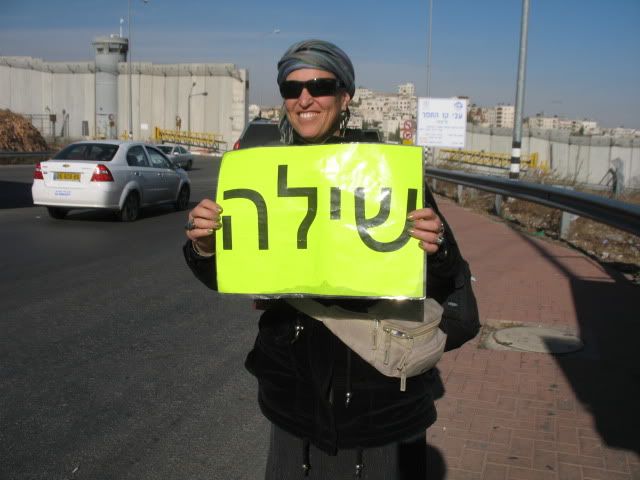
The best rides are when I'm taken via Kida/Shvut Rachel which at its worst will leave me a mile or kilometer and a half from my house. But recently, after hectic stressful searches for a ride out, which leave me with little patience to teach my difficult students, I end up with a ride that drops me off at Givat Asaf, the Beit El junction. When there I whip out my שילה SHILOH sign to attract drivers going north. That's what happened yesterday. I caught a ride, thanks to the sign of course, to the Shiloh Junction, where I got a ride to the Shvut Rachel-Shiloh Junction, then another ride to the middle of Shiloh where the stores and Kupat Leumit clinic are. And there I got tired of waiting, started walking up when a neighbor stopped to give me a ride to my door, B"H, thank the Good Lord!!

Tuesday, February 23, 2016

Why Grandmothers and Others Tremp aka Hitchhike

Even bus stops aren't all that safe and comfortable, especially when you don't know when the bus will arrive.
One of the things that kept me from falling asleep last night was wondering what to blog here on Shiloh Musings this morning. I do try t keep my blogging topics varied and interesting and from a perspective you may not get anyplace else. I guess you'd call this one in the "not get anyplace else" category. How many retirement age grandmothers admit to hitchhiking besides yours truly?


It's not that I have anything against buses. There are times I really look forward to taking a bus for the comfort and quiet and chance to say my daily Tihillim Psalms or the Mincha Afternoon prayer. When my husband travels home, especially, heavy bags from the shuq, open air Machane Yehuda Market he has been known to wait hours for a bus to Shiloh rather than struggle with his bulky, heavy bags and tall frame in a small crowded car seat.

 Our buses do not stop
on the road.
Why would he be waiting so long when there are generally one or even two buses to Shiloh from Jerusalem when he's on his way home? Well, that's the schedule, but sometimes the buses just don't arrive. Apparently there aren't any spare buses. That means that the very impressive bus schedule that the "powers" worked out took for granted that no bus would ever break down, and all drivers would be in good health and show up as scheduled. Of course in the real world you need backup plans, and when you don't have good ones, innocent, trusting travelers are left in the cold. And we are also in a panic.
If we take another bus in order to get to a bus/hitchhiking stop will we see our bus passing and then miss it?
That's the "Murphy's Law" for travelers like us? If we take a ride to Ofra, we may have to run like mad, or end up missing the bus if it comes quickly. And if I take a ride to the Shiloh Junction, there is a bus stop, but few drivers pick up passengers there. A number of times I've ended up waiting either there or at the Shvut Rachel-Shiloh Junction where no bus stops at all.

So you must wonder why I tremp. First of all, you should know that most of the drivers are friends or very familiar people, considering that I've been living in Shiloh for over 34 years. I know lots of people from nearby communities and my work in Yafiz, Sha'ar Binyamin. We do quick profiling, as do the drivers.

I'll give an example of what happened to me the other day. I was on my way home and had taken the lightrail to Ammunition Hill, which is near Ramat Eshkol and French Hill, Jerusalem. From there I walked to the bus stop on the top of Eshkol Blvd. There was supposed to be a bus in a few minutes, so I waited, and I waited. And I didn't get on any of the buses that could easily have taken me to the "cityline," the border of Jerusalem, where there are buses and tremps. I was waiting for the bus that would take me just a few steps from my house. Yes, I have absolutely nothing against taking buses. But the bus never came. I was getting tired of standing, and if you're wondering about safety, there's no guarantee that standing there is any safer than standing at the "cityline."

Finally, when a bus to Ariel, which doesn't stop in Shiloh, came I got in. I was able to use my train ticket's free transfer which made the trip free until the Psagot/Tel Zion/Kochav Yaakov stop. But I got off at the "cityline." And just as I got off, a neighbor pulled up, so I got in, and someone told me that another neighbor was right behind her. She took me straight to my door. To me, that was the sign that I had done the right thing by tremping.

I think the bus came just a few minutes later, but since I had no idea it would be arriving at all, I think I did the smart thing. Too many times my husband reports that buses didn't show at all, and there's a limit to how long anyone should stand helplessly at a bus stop.

Yes, that's me at the "cityline." Those signs are no longer there, but cars still stop supplementing the bus service.

Sunday, December 6, 2015

Branding "Life in Shiloh/Binyamin" to Sell in Tel Aviv

Last week I attended a workshop/seminar run by our local "county," Mateh Binyamin, the Benjamin Regional Council, on how to deal with the media in all types of circumstances and market life in our small towns.


It was held in Yekev Psagot Visitors Center, which is set up to do more than just sell their excellent Psagot wines. As you can see there's a small auditorium. We were given the lowdown, behind the scenes reports on how some of the Binyamin communities coped with the deadly results of Arab terror attacks and reporting to the local and international media.

We live under a magnifying glass, and life isn't dull here. Every single community has some very tragic stories to tell, and we must know how to tell them in a way that shows that nothing will drive us from our homes. We also must protect the families that have been brutally touched by Arab terrorism.

The Regional Council has a professional public relations agency to assist, and one of the more amusing parts of this workshop was when it was mentioned that those professionals, who aren't local, had been transported to the Psagot Winery, just above Mirgron, only a few kilometers north of Jerusalem, by the council in a bullet-proof vehicle. Suddenly there was a big hullabaloo, with people shouting that the road was not considered dangerous, and "Tel Aviv visitors" didn't warrant such special treatment. The participants were arguing over the need for rock-proofing their windows, also, which the government actually pays for if one applies. BYW public transportation Egged Tavura uses ordinary buses to most of the area; only north of Ofra lines, like those to Shiloh, get the bulletproof busses. In all honesty, there have been shootings south of Ofra and even near Psagot, but Jewish residents of that part of Binyamin prefer to think of themselves in a safer place than Shiloh for example.

We were asked by the Public Relations experts for examples of ordinary and exemplary life in the yishuvim so that they could coach us in how to publicize it. And when I mentioned that there are home-grown players and the head coach of the Jerusalem Lions Big Blue Tackle Football Team, I was told that nobody in Tel Aviv would be interested in the fact that there's American football coming out of Mateh Binyamin.  They said that American football does not interest Tel Aviv. (Davka, last week's big victory by the Lions was over the Petach Tikva team.) That's when it hit me that I market (blog) to a different audience.

As everyone can easily see, I write in English, although I have no problem speaking Hebrew and understanding it. Therefore my audience is either abroad (Jews and non-Jews) or other Israelis like myself.

Apparently, the regional council has these workshops periodically, and I'll attend more to see what tips I can get from the experts. But I was disappointed that their focus is so parochial or short-sighted, especially when Israeli politicians and media keep touting that we must please the outside world.

What do you think? I'm curious; please comment, thanks.

Wednesday, July 15, 2015

More About Arabs on Jewish Buses, Big Problem!

Arabs getting on #86 at Beilinson
Hospital 
Petach Tikvah
Yesterday, again, I had to deal with the cons, the problems, the disadvantages of Arabs on Jewish buses in the Shomron, Samaria. I must say that we do not have that situation in the Benjamin District, probably because our buses all go into Jewish communities, and that is forbidden for Arabs without papers. 

Arabs getting on #86
at Beilinson Hospital
Petach Tikvah
The Afakim bus company which goes from the Shomron to Petach Tikva, Ariel and Tel Aviv, has many stops on the main road, which brings the Arabs who work in Israel (the Tel Aviv area) near their towns and villages. That is not the case for us. The only stops I've seen Arabs get on and off are Pisgat Zeev and Sha'ar Binyamin, and those Arabs all have permits/papers allowing them into Jerusalem.

In Israel the public transportation, bus companies, although businesses must follow certain government guidelines. That especially pertains to those buses that go to Judea and Samaria, and that is because our bus fares are discounted. The government calculates the number according to Israelis whom they estimate will ride the buses, not taking into account that they permit Arabs to ride them along with us. The result is simple to predict. They buses are full. The buses are overfull, and Jewish Israelis are left waiting.

overfull bus didn't let us on at Tzomet Yarkon (junction)
I was dropped off to wait for a bus to Ariel at Tzomet Yarkon (Junction) yesterday, and I couldn't believe how many people were waiting. Foolishly, at first I thought is was a good sign, that they, wiser than yours truly, knew that buses were about to come. But the sad truth was that buses had come and went without letting on a single passenger. There wasn't even standing room. They were overloaded with Jewish and Arab passengers. The buses just don't come frequently enough. By the time they reach that bus stop, they are packed, like New York City Subways at rush hour. And unlike the subways, they have a driver who controls the doors. Passengers are let off via the back door, while the front door stays shut.

Lucky for me, I'm an experienced trempistit hitchhiker and bus passenger hailing from New York, and I got to the very front when a bus finally did let a few of us in. There were well over a dozen exhausted people left standing in the hot sun waiting for yet another bus.

I had to travel standing most of the way to Ariel. I was one of the only females standing, and I was definitely the eldest standing. The others looked younger than my kids.

If the Israeli government is going to permit Arabs to travel on these buses, they must make sure there are enough buses on the roads for all!!

Saturday, July 4, 2015

The Death of the Jerusalem Central Bus Station

Cross-posted on me-ander 

I used to love the Jerusalem Central Bus Station, because it was a lot more than just a bus stop. The present building is relatively new, having been totally rebuilt and only opened in late 2001. It was/is a small, easy to navigate mall, with buses and a synagogue (that even has a room for women to doven or say Tihillim, psalms,) shops and food places of all sorts. It used to be pleasant enough as a mall just to go in to shop or eat.

I had heard all the reports about the high levels of air pollution and the fact that it hadn't been planned well, but that was more a danger to those who worked there, who spent hours there day after day. For the traveler or shopper there was always less danger.

But just under a year ago we, travelers to and from Judea and Samaria were totally banished from there. OK, we can go and take a bus to Sderot or Tel Aviv, but we can't take a bus to Shiloh or Tel Tzion.

A few weeks ago, I had some free time and decided to walk in. I must say that I was shocked. Even though the bus station is relatively new, it looked like a dump.


Not even the clock works! A bus station should have clocks, working clocks, all over, in every direction.


And this electric board that used to give me information about buses to all over the country is dead. How could there be no basic maintenance in a building as important as the Jerusalem Central Bus Station?


Do you see the "No Signal" sign?

In its heyday, when all the platforms were being used by a number of lines, the area on the right of this picture would have been lit up with information about the schedules. Now it's dark.

Fewer bus lines means fewer passenger which means fewer customers for the stores meaning that it gets harder to rent them out.

The CBS as the signs call it, looked dark and dreary. Maybe it has no future...

Wednesday, July 1, 2015

Mobs of Arabs on Jewish Buses

There has been a lot in the news about whether or not Arabs should be allowed to travel in Jewish buses. There are Arab buses, at least in the Jerusalem area, beautiful new white ones of all sizes. It's rare for Jews to go near them even when it would be convenient. But the Ariel buses are a different story. Yesterday when I traveled from Tel Aviv's Tel Hashomer Hospital back to Ariel in order to get home to Shiloh I found out just how many Arabs travel on the same buses as Jews.


It would be no exaggeration at all to estimate that easily three quarters 3/4, yes, that many, of the passengers on the 86 from Belinson Hospital in Petach Tikvah, where I had changed from the 87 from Tel Hashomer, were Arabs.

There aren't security checks at the "barrier" in the direction of Ariel, unlike towards Petach Tikvah/Tel Aviv etc. And, unlike the "city line" Hizma "barrier" at the Jerusalem border, security inspectors do enter the buses going towards the shefela, coastal area.

By the time we entered Ariel, the bus was almost totally empty. The only passengers were Jews, and I was one of the maybe two who got off at the last stop by the university.

And just in case you are wondering. I sat in the front seat. There was a Jewish woman who sat next to me until the Rosh Ha'ayin stop. Then an Arab, who was clearly a laborer, about 50 years old sat next to me. We each sat as far apart as possible. That was fine until he fell asleep. I had to nudge him by knocking my bag onto his to wake him up and stay away. And, yes, I'd do the same to any man.

B"H, thank G-d nothing unpleasant happened to me, and I didn't hear of anything while traveling. But as a woman of my age, I'm not a target.