Hamas War

Showing posts with label Sukkot. Show all posts

Wednesday, September 26, 2018

Succot ושמחת בחגך Why the Joy?

One of Judaism's interesting questions is:
Why is the Succot Holiday called the "Joyful" one? ושמחת בחגך
The other day, while walking outside in Shiloh and wondering when Gd will bless us with cleansing and health-producing, also necessary for agriculture rain, I noticed the grapes.  OK, I didn't need to go very far to see grapes, since we have a few vines by our house.

The grapes are rather dusty, and some are dried out, eaten by birds, bees etc. And the leaves are awfully brown and ripped. But there are still grapes for humans to feast on.


I began to think of how it must have been in olden times, a few thousand years ago, when food storage meant drying and pickling food. Instead of refrigerators, freezers and modern containers, they used caves and ceramic urns. 

In this late summer season, people couldn't rely on piped water from high tech reservoirs, desalination, drip agriculture etc. It hasn't rained for six months. We frequently complain of the high prices of fruit and vegetables, because the summer crops are finished and the winter ones can't grow without water. The products of modern high tech agriculture isn't cheap.

How did our ancestors manage? During the almost four hundred years of the Mishkan, Tabernacle in Shiloh, there may have been grapes growing right where my grapes grow today. Considering how easily grapes grow here without any professional care, it's obvious to me that this is the Land Gd created for grape growing.

Finding and preparing sufficient food for the many late summer, Tishrei holidays is challenging enough in today's modern world. It's hard to imagine how much more difficult it was thousands of years ago. And then think of the joy when the food was served. Or many the mitzvah, the commandment to be joyful helped them enjoy what they could find to eat.

In Ancient Times, I doubt that the sukkot one lived in during the holiday was built onto people's homes or terraces. They left the comfort of their home to go up to Shiloh and later to Jerusalem for mass prayers. Conditions weren't like today's hotels, three enormous meals and unlimited afternoon cake. Vineyards like mine were treasured and shared, since there wasn't much to eat.

People were grateful and joyful for what they had ושמחת בחגך Visamachta bichaggecha, And be joyful in Your holiday.

Sunday, September 23, 2018

Succot Now and Way Back When, Memories


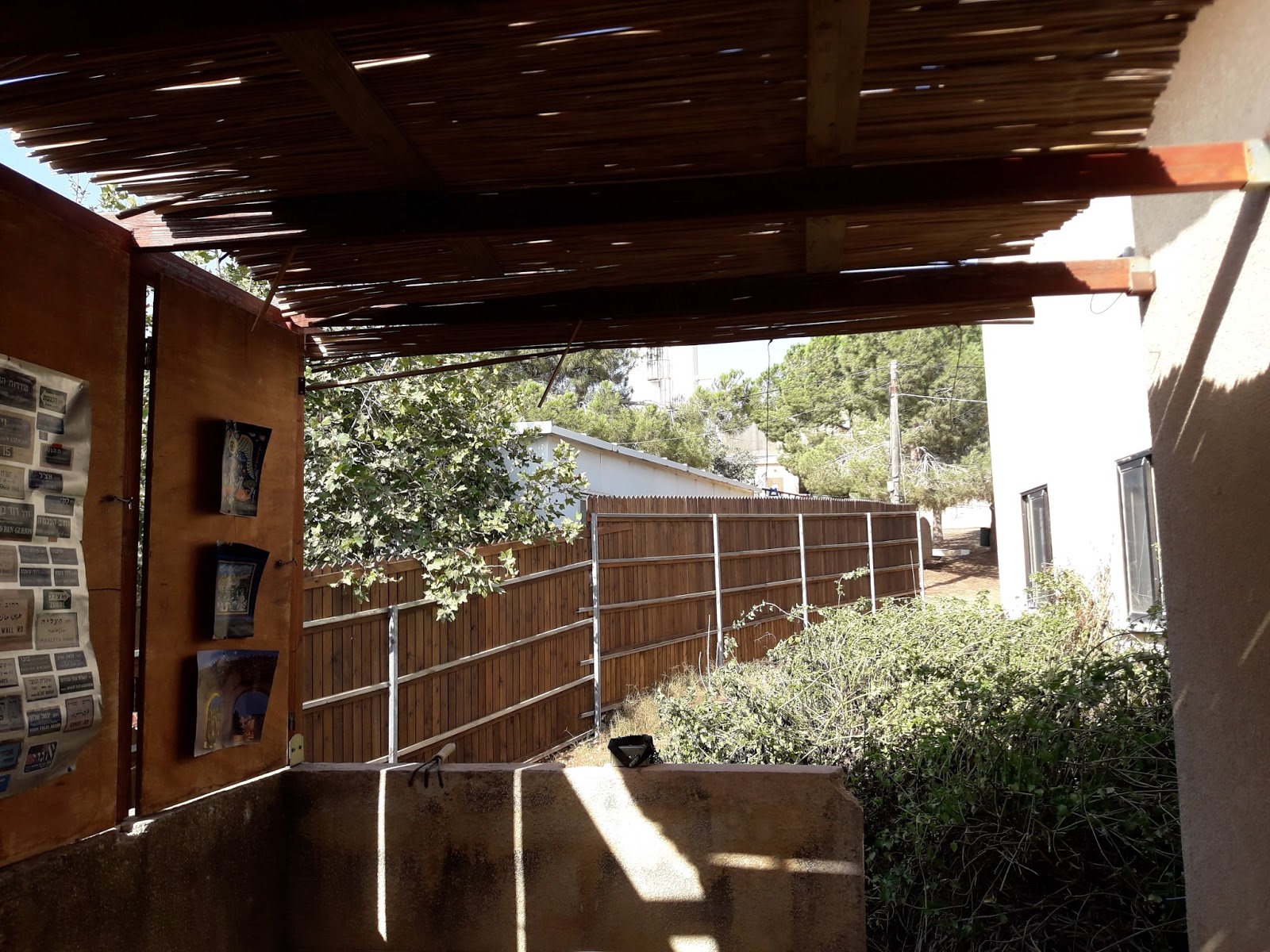
Here's a collage of this year's succah decorations. We've had our own family succah all but two years we've been married, though neither my husband nor I grew up with a succah.

I remember that our Oakland Jewish Center, Bayside, NY, Hebrew School had us "decorate" or enter a succah before the holiday. There was a major "disconnect" concerning Succot, because it wasn't a holiday we really celebrated. School in our very Jewish neighborhood was cancelled on Rosh Hashanah and Yom Kippur, but not Succot. I do have some memories of visiting the Rabbi's home and seeing a decorated hut by their house, since my aunt was a close personal friend of Rabbi and Mrs. Issacson. But until I began becoming religious in high school, after we had moved to Great Neck, Succot Holiday and the sukkot huts weren't part of my Jewish Life.

My husband's family was more traditional, but they lived in an apartment, so the succah was just whatever the shul had built.

Our first year married and in Israel, we lived in the Maon Betar in Jerusalem's Old City. We didn't have a succah, but we carried our main meal to the Bnai Akiva succah, which wasn't all that far away. The following year, we were in our very own apartment in Bayit Vegan, which actually had two balconies suitable for a kosher succah.

The first years we used the one off of our bedroom. A  close friend met my husband in Machane Yehuda and helped him buy all the equipment needed. Then she came over to help assemble it. We didn't even have enough chairs for all the guests we had invited. I don't know how we fit everyone into the succah for the meals, but we did.

When we planned our Shiloh home, a 2x5 merpeset seemed nice and big, but now, bli eyin haraa, we can't fit the entire family inside the succah, unless we just stand sans table. Or we can have a small table as buffet and stand around it eating. The kids decided that they're coming over for lunch before Simchat Torah, a time when we can eat indoors.

Now I'm looking forward to the holiday and wonder when the rains will start.

ושמחת בחגך
Have a Wonderful Joyous Succot Holiday

Sunday, October 8, 2017

Looking Through The Sukkah at Kohelet, Ecclesiastes

There's a time for...

Chazal, our sages decided that the book of Kohelet, Ecclesiastes should be read during the Succot holiday, which Gd commanded that we celebrate just as summer becomes winter. This is a time of the year when the weather here in the Holy Land can be very unpredictable.

We've been living in Israel for almost half a century. I have memories of days so hot they rival sumer and also rainstorms that had us in the house rather than the sukkah. There have also been years with such winds that the sechach, the special "roof" blew off the sukkah. And other families, whose sukkot are less sturdy than ours, lost theirs completely.

Kohelet, Ecclesiastes has a very well-known section in Chapter 3, which reminds us that there's a season for all things:
1Everything has an appointed season, and there is a time for every matter under the heaven.אלַכֹּ֖ל זְמָ֑ן וְעֵ֥ת לְכָל־חֵ֖פֶץ תַּ֥חַת הַשָּׁמָֽיִם:
2A time to give birth and a time to die; a time to plant and a time to uproot that which is planted.בעֵ֥ת לָלֶ֖דֶת וְעֵ֣ת לָמ֑וּת עֵ֣ת לָטַ֔עַת וְעֵ֖ת לַֽעֲק֥וֹר נָטֽוּעַ:
3A time to kill and a time to heal; a time to break and a time to build.געֵ֤ת לַֽהֲרוֹג֙ וְעֵ֣ת לִרְפּ֔וֹא עֵ֥ת לִפְר֖וֹץ וְעֵ֥ת לִבְנֽוֹת:
4A time to weep and a time to laugh; a time of wailing and a time of dancing.דעֵ֤ת לִבְכּוֹת֙ וְעֵ֣ת לִשְׂח֔וֹק עֵ֥ת סְפ֖וֹד וְעֵ֥ת רְקֽוֹד:
5A time to cast stones and a time to gather stones; a time to embrace and a time to refrain from embracing.העֵת לְהַשְׁלִ֣יךְ אֲבָנִ֔ים וְעֵ֖ת כְּנ֣וֹס אֲבָנִ֑ים עֵ֣ת לַֽחֲב֔וֹק וְעֵ֖ת לִרְחֹ֥ק מֵֽחַבֵּֽק:
6A time to seek and a time to lose; a time to keep and a time to cast away.ועֵ֤ת לְבַקֵּשׁ֙ וְעֵ֣ת לְאַבֵּ֔ד עֵ֥ת לִשְׁמ֖וֹר וְעֵ֥ת לְהַשְׁלִֽיךְ:
7A time to rend and a time to sew; a time to be silent and a time to speak.זעֵ֤ת לִקְר֨וֹעַ֙ וְעֵ֣ת לִתְפּ֔וֹר עֵ֥ת לַֽחֲשׁ֖וֹת וְעֵ֥ת לְדַבֵּֽר:
8A time to love and a time to hate; a time for war and a time for peace.חעֵ֤ת לֶֽאֱהֹב֙ וְעֵ֣ת לִשְׂנֹ֔א עֵ֥ת מִלְחָמָ֖ה וְעֵ֥ת שָׁלֽוֹם:


Considering the unpredictability of the weather during Sukkot, you'd think that Gd would try to make it a bit easier and command us to live in these "temporary huts" for Shavuot, which falls in early summer, late spring. But Gd must have wanted to challenge us. Life isn't supposed to be easy.

There are good Jews who live in places in which there are frequent snowstorms or hurricanes just when Sukkot is on the calendar.

On Sukkot, we're, davka, commanded to be happy and celebrate. If someone dies and/or is buried during Sukkot, mourning is postponed. That's because we must learn to separate our personal joy or sadness with our religious/national feelings. We must remember that, contrary to pop/modern psychology, we are first Jews and part of a unique People/Nation.

It's not even a matter of simple "Gd will take care of us." We must remember that after This World, there is another. And that is the place where we enjoy or suffer for how we lived our lives here.

Chag Sameach