|
| Photo by Nir Kafri |
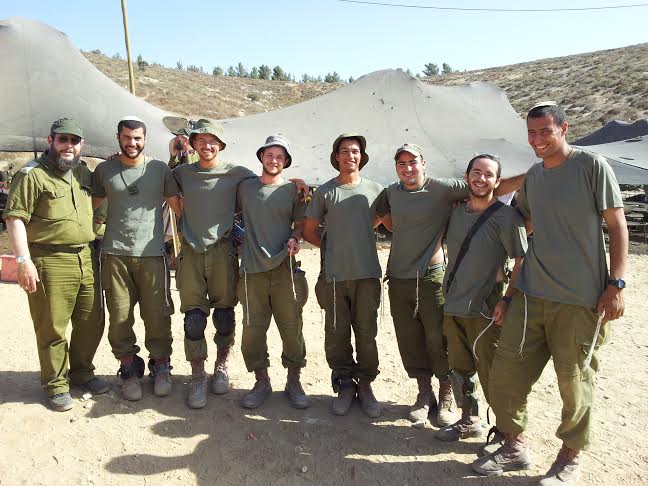
While the very anti-Chareidi Jerusalem Post's "In Jerusalem" had a piece about an injured chareidi soldier being shunned by his family, there were many more stories about how chareidim were filling the hospital wards trying to support and aid IDF wounded and their families. Those were the stories I heard from neighbors whose son was wounded.
Older stories about how very distinguished rabbis, accepted and respected as chareidi had reacted in the past honoring IDF soldiers and the uniform were also back "in print."
 |
| Noam Moshkowitz/EPA |
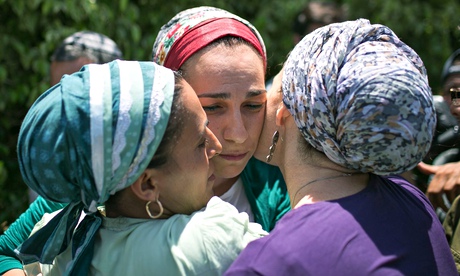
What surprised me the most was the amount of religious staff in the media. I had never seen so many men in kippot or women with various hair-coverings holding the microphone interviewing people and reporting on the situation.
For the past couple of decades, our dati le'umi youth have been encouraged to enter the media as their profession. My own children didn't, but it's clear that many others did take that advice. And during the weeks of the war the veteran news-media stars couldn't be everyplace, so the lower tiers of workers had their chance in front of the camera. And they proved themselves very competent.
Back to the IDF and the point of this article...
This war was a very modern media in your face war. Everything seemed to be on camera or just a shout away. Everyone effected had their 15 minutes of fame, and we heard horrendous, though brave, stories of attempts to rescue body parts of dead soldiers. Wounded soldiers in hospital beds, bandaged and connected by tubes could only say that they waited to recover and join their comrades to defeat the enemy.
This level of pikuach nefesh, risking one's life to save another Jew is the highest mitzvah, Torah commandment one can do. It doesn't matter what hechshar, rabbinic supervision you have on your milk or meat if you won't risk your life for your fellow Jew. The IDF soldiers, the IDF medics, the hospital staff, not only the doctors, worked so hard to preserve Jewish Life and to also preserve the State of Israel.
More and more chareidim are seeing this. That's why it was a chareidi Jew who established Zaka, and that's why you see so many chareidim as medics in the various first aide NPs here in Israel. And that's one of the reasons there has been an increase in the amount of chareidim joining the IDF as soldiers. It's getting harder for the anti-Israel element in the chareidi world to declare the IDF as evil sinners. Not only Israel, but World Jewry owes everything to the holy bravery of the IDF and its soldiers.
*Following is the story that inspired me to write this post. I received it in the email bulletin send out by Chabad of Arizona:
Position Available
During the month of Elul, a maggid (traveling preacher) came to Beshenkovitz, where Reb Shmuel Munkes' lived. Reb Shmuel was a beloved chasid of Rabbi Shneur Zalman, founder of Chabad Chasidism. Though known for his sharp wit and "chasidic pranks," Reb Shmuel was no empty joker. He was a deep personality, one who could abide no falsehood, and whose own ego was completely nullified to perform the will of his Creator.The townspeople saw the maggid's letter of introduction which referred to him as a great tzadik (righteous person), who traveled from town to town only to arouse and inspire Jews. Being G-d-fearing people, they immediately invited him to speak and inspire them to serve G-d better.The maggid began his speech. Over and over again, he accused his audience of committing terrible sins. His entire speech was filled with accusations and descriptions of the terrible punishments awaiting them because their evil behavior had aroused G-d's anger. Only if they would wholeheartedly repent would they possibly have a chance to be spared. The townspeople were utterly broken by the maggid's harsh words, and they cried bitterly, fearing the awesome punishment.After his speech, the maggid, satisfied with himself, retired to the room that the community had arranged for him.A short while later, Reb Shmuel entered the maggid's room. He carried with him a long knife and a stone with which to sharpen it. Reb Shmuel closed the door behind him and then bolted it. Without saying a word, Reb Shmuel began to sharpen his knife.A few tense moments passed. Finally the maggid broke the silence and asked in astonishment, "Sir, could you please tell me what you are doing?"Without glancing up from the knife he was sharpening, Reb Shmuel answered, "As the honorable, great maggid knows, we are very simple people in this town. Perhaps, it is because of our unintentional sins that we have never merited to have a great, righteous, G-d-fearing scholar in our midst."Not knowing what to make of this answer, the maggid replied, "Yes, that is true. Nevertheless, what does that have to do with sharpening the knife?"Reb Shmuel answered simply, "We were taught by our parents that before Rosh Hashana, one is supposed to pray at the graves of the righteous."Still unsure of what Reb Shmuel's point was, the maggid asked, "That is correct. But why are you sharpening that knife?""Oh, that is very simple," explained Reb Shmuel. "The nearest grave site of a righteous person is very far from our town. For some of us it is extremely troublesome and difficult to make such a long journey."With these additional words, the maggid began to feel uneasy. He started sweating and ventured, "But you still have not explained why you are sharpening your knife in this room!"Reb Shmuel answered, "Quite simply, I am sharpening my knife here because the townspeople want a very righteous person buried in this town."Now the maggid had not even a shadow of a doubt as to what Reb Shmuel's intentions seemed to be. The maggid stammered, "But I am not completely righteous. I have also done some small sins, such as ..."Reb Shmuel dismissed the maggid's revelation, saying, "Honored maggid, you are still a very righteous and learned person. As for the sins that you mentioned, I did not even know that they were transgressions."The maggid trembled and stuttered, "But I did some transgressions that were much more serious, such as ..."Concerning this revelation, as well, Reb Shmuel shrugged, insisting, "But to us you are still a tzadik; for us, you are quite good enough."This strange dialogue continued for some time with the maggid, mentioning more and more severe transgressions and Reb Shmuel telling him, "But you are still acceptable to us, since you are far better than we are."Finally, the maggid admitted to some extremely serious transgressions and that he was not really the great righteous man that his letter of introduction and credentials claimed him to be. In essence, he was saying, "I am an impostor."Now, Reb Shmuel no longer played the simpleton. After putting away the knife, he began chastising the maggid for causing the Jews of the town so much pain and sorrow. After making sure the maggid fully understood how one is to talk to and treat another Jew, Reb Shmuel unbolted the door and let the maggid go on his way, much wiser and more sensitive than before.
~~~~~~~~~~~~
Source: Supplemented by Yerachmiel Tilles from //lchaimweekly.org (#986).Biographical note: Rabbi Shmuel Munkes (1834-1882)], an elder disciple of Rabbi Shneur Zalman of Chabad, was known for his fervent and creative Chasidic service. Stories abound of his sharp wit and "chasidic pranks". He lived in Beshenkovitz and then in Kalisk (or the reverse?) in (or near?) the district of Polotz.