Hamas War

Monday, September 16, 2013

BBC, Wonderful! Israel Wasn't Mentioned in Its Syria News

While trying to find out more about the shooting in the American Navy location that killed at least a half a dozen people, we had the BBC on.  Most details about the shooting were still considered top secret, so they had a long piece about Syria, its refugees, Turkey and Lebanon.  I kept listening and listening for a mention of Israel and didn't hear one.  Honestly, I was surprised.  It's not that Israel is involved with Syria, it's just that for some really dangerous and fokokt  reason Obama and Netanyahu have made it an Israeli issue, rather than one of Middle East and World Peace.

screen capture: Channel 10 news
The Newscast focused on Lebanon and Syrian refugees. It was just such a pleasure not to hear them talk about Israel.  What could they say about Israel? Well, they could say that Israel has accepted quite a number of injured Syrians and given world class medical care.  It's pretty obvious that the international press isn't going to give that story much play.  It'll make Israel look good.  Of course I like the idea of Israel looking good.  We are the best country in the world, warts and all.  Nobody's perfect...

A good thing for Israel in that most international media aren't talking about the great chessed, loving kindness Israel does for the Syrians is because we don't need the Syrians to focus on us as allies of their enemies.  I have no doubt that Assad knows perfectly well that we've been helping, but I think we're safer if the fiction of isolation continues.

PS The United States is looking more and more dangerous.  I feel a lot safer in Israel.

Shimon The Dangerous Peres, Wrong Again

Hat tip: Rafi, Life in Israel

President Shimon Peres,
2012 President Conference
Photo Batya Medad
40 years have passed. Most of Israel's citizens did not personally experience the shock of the fearful siren, wailing up and down, that at 2 PM ripped through the silence of the holiness of Yom Kippur. The nation was wrapped then in its fast, gathered in the synagogues, or in the privacy of their homes. The gates of heaven were not open that day, the prayers were not answered, the war broke out. The fire was on two fronts, the north and the south, by the time the siren sounded, the first soldiers had already fallen. Israel had made a mistake and was surprised, and her children gave their lives with amazing heroism and saved it from the valley of tears.  -- President Shimon Peres, at memorial ceremony on Har Herzl for the fallen soldiers of the Yom Kippur War
Israelis, like many other people tend to credit themselves and other humans for good things and blame G-d for the bad.  I see like in the complete opposite direction. We humans tend to misuse our gift of Free Will and make the wrong decisions.  I'm not talking about buying the wrong color dress,  a boring book or even a lemon  of a car.  I'm talking about dangerous things, like the Israeli Government decisions that caused the horrendous death toll in the first days of the 1973 Yom Kippur War and almost caused the destruction of the State of Israel.

Immediately after the 1967 Six Days War, the country was filled with signs thanking the IDF for the victory, even though the great victory bore no relation to the battle plans.  In simple terms, G-d took over steering the ship.  While the Israeli Labor-ked Government had always made it clear that it was perfectly satisfied with the Land under Israeli control since the 1949 ceasefire, G-d decided otherwise.  And instead of recognizing that G-d knows more than man, successive Israeli governments for the past forty-six 46 years have been begging the Arabs to take back the Land we won in a fighting for our lives and existence defensive war in exchange for a "peace treaty."

Shimon Peres personifies that faulty reasoning.  For whatever reason, G-d has made him one of the last, if not the very last of that generation that refuses to accept G-d's will.  And Peres, instead of recognizing and admitting his mistakes has continued for almost half a century taking credit for our survival and promoting his faux peace.

I'm not as optimistic as MK Elkin who thinks that Israelis have "sobered up" and recognize the futility of their quest for peace.

I think a serious step would be when we hear Israeli and Jewish leaders thank G-d for stopping the Holocaust and blaming human free will for causing the death of millions.  All of this philosophy and history are related.  That's the key.  We're still stuck in the syndrome of the "Sin of the Spies," when ten out of the twelve tribal leaders feared the challenges of liberating aka conquering the Promised Land, and they sold their faulty opinion to the masses of recently enslaved Jews.  It seems we're still sentenced to wander the desert and await a Joshua to lead us into Jewish Sovereignty in the Holy Land.

Sunday, September 15, 2013

What Should We Believe re: Chemical Weapons, Iraq, Syria, Obama, Peace etc.?

We live in very confusing, tricky times etc.   Along with the blessings and advantages of instant communications, internet and more, there is also the downside.  Anyone can post anything, truth, lies, tricks etc. It was once a schlepp to get over to someone's wagon or tent to hear his message, but now, you just have to answer your phone or turn on your computer or television. You don't have to leave the comfort of your favorite chair.

So, you tell me:

Are we supposed to believe that United States Secretary of State Kerry can broker a deal to make "peace" between Israel and the Arabs?

Has Syria been secretly transporting its chemical weapons to Iraq? Or is that untrue?

Will the latest "Arab spring" bring a breath of freedom and fresh air?

Has United States President Barack Hussein Obama made the right decision to go with Russia on Syria?

Is the "Two State Solution" the savior of the State of Israel or could it be the cause of its destruction?

Everybody claims to "KNOW."  But considering how few people really agree with each other, then it's obvious that they don't know because two conflicting opinions/facts can't be right.

Today while paddling around the pool, I was talking health and recipes with a friend. She asked how I cook vegetables.  I told her that I use plain old-fashioned soy oil.
"But I've been told that olive oil is healthier."
"Yes, it is, but I don't think that it's any healthier after being cooked.  The experts say that we should only use cold-pressed olive oil, because the heat can destroy the goodness, vitamins, minerals.  Cooking with olive oil then destroys even more.  So I use olive oil in salads but not for cooking."
Yes, that's an example of how my mind works.  I don't cook with honey for the same reason.  If heating the honey for commercial production isn't good for the honey, then heating it for cooking can't be good either.

I look and listen to what the Arabs are saying.  I consider the Palestine Media Watch site to be extremely important. Instead of listening to politicians and the media projecting their presumptions, I want to know what our enemies are saying to each other and their people.  They are not educating for peace with Israel.  They are education, promoting the total destruction of the State of Israel and the banishment of the Jewish People.


They have been very clever in how they do it.  This was explained with multiple illustrations at the event memorializing Emanuel Winston, Twenty Years Since the Oslo Accords. Unfortunately, the Jewish People hasn't been using its advertising and promotion talents to counteract the Arab campaign.

It's time for us to take the lead, isn't it?

Saturday, September 14, 2013

After Yom Kippur, Time for The Next Mitzvah

There's a custom to start building sukkot immediately after Yom Kippur. Since our "slates" have been wiped clean of sins, we want to fill up our account with Mitzvot.  That's why many people rush out after breaking the Yom Kippur fast and start getting their sukkot ready.

One thing I've been noticing is that people are starting to build sukkot earlier and earlier every year.  And the businesses selling supplies for building and decorating sukkot open earlier, too.

These are pictures I took last week in Jerusalem.  It seems to be that people are looking at post-Rosh Hashannah for the time to work on their sukkot.


The enthusiasm to fulfill the Mitzvot is very encouraging.

Chag Sameach! Shannah Tovah!
Have a Joyous Holiday and Wonderful Year!

Friday, September 13, 2013

Terrorism, The Arab Reponse to Israel's Call for Peace

Please find the time, either before or after Yom Kippur to read Caroline Glick's Israel's twenty year nightmare.  It's an important article, full of truth.
Twenty years ago today, Israel's so-called peace process with the PLO was officially ushered in at the White House Rose Garden. 
A year or so later, when the death toll of Israeli victims of the massive terror offensive that the PLO organized shortly afterwards reached what then seemed unbearable heights, a popular call went out to "Put the Oslo Criminals on Trial." 
Needless to say, with Shimon Peres, the architect and godfather of the so-called peace process now serving as the President of Israel, nothing ever came of the call.
The demand for an accounting was not unprecedented. There was no reason, on the face of things for those who made it to be perceived as anything other than reasonably enraged, and responsible citizens insisting that those responsible for the largest, most destructive strategic error Israel has ever made pay a personal price for their actions. 
Twenty years before that ceremony at the White House, Israel suffered the worst military defeat in its history...
Yom Kippur is a very important day in the Jewish Calendar.  Jewish tradition is to reflect and repent in honor of the New Year.  Usually we feast on holidays, but not on Yom Kippur.  On Yom Kippur the body takes a backseat to the soul.  The fact that the Arabs attacked us, davka, on Yom Kippur and expected us to fold, rather than rally and fight just shows how they don't understand our nature, our mentality.

Too many of our politicians, "thinkers," media etc., then, like now, kept harping on the quest for peace, peace at any price.

I remember too well a discussion I had with another young mother in the late 1970's, before then Prime Minister Menachem Begin's surprise announcement that he'd be giving Egypt's Sadat the Sinai.  The other mother was trying to convince me that it would be good to give away the Sinai.  Her sole reason was:
"Do you know how far away it is when my husband has to do milu'im, reserve duty?  Why should he have to travel so far?"
I was incredulous.  "Do you want the war closer?"
Unlike me, who had been born and raised abroad, this young mother was Israeli raised.  She didn't even attempt to convince me that giving the Arabs the Sinai would give Israel peace.  All she wanted was to keep her husband closer to home.  At that point, I had no idea that I was predicting terrorism as the result of a Sinai withdrawal, no matter what the reason for the withdrawal.

Terrorism is a "convenient" war; it's close to home.  For the Israeli who doesn't want the hassle of schlepping his army equipment, and bag of books for reading in his spare time as my husband always did, by shrinking Israel we can bring the battles to your home.

As Caroline Glick writes, none of these "peace agreements" have brought us true peace.  We were conned.  And the really awful fact is that we were conned by our own people, by Israelis, by Jews.  None of these peace sic agreements gave us peace.  Our security is more perilous than ever.  We gave peace a chance and got terrorism.
 
Gmar Chatimah Tovah
May G-d Give us Life and a Another Chance


Cantor Eliezer Schulman's voice is the one I hear in my head when I think of chazanut.  I discovered Torah Judaism in the Great Neck Synagogue of Cantor Schulman and Rabbi Efraim Wolf.
Cantor Schulman began his career at age 17 as the cantor in the Russian Shul in Newark, New Jersey. He served in the United States army for 4 years overseas earning a purple heart , bronze star and several ribbons for good conduct. After his discharge, he married and moved to become the cantor in the Ave. N Jewish Center in Brooklyn. A decade later he became the cantor in the Great Neck Synagogue in Great Neck, NY. He remained in that position for 40 years. Cantor Schulman passed away right before Pesach in 2005. He left a legacy of Jewish songs, cantorial music and inspiration to all who heard him

The 1973 Yom Kippur War, Israel's Greatest Moment

Most people consider the 1967 Six Days War to be Israel's greatest victory.  It was miraculous, cinematic, larger than life.  I remember it well.  But having also lived through the 1973 Yom Kippur War, I don't think the Six Days War was as great a victory.

In 1967, we had almost a full month of preparation, spiritual, emotional and military.  Of course as everyone knows, G-d changed the battle plans and even though the Israeli Government had ordered the IDF to preserve "status quo," we ended up liberating the Golan, Sinai, Judea, Samaria and the Jordan Valley.  The alternative was to end up a state destroyed, a postscript in history, drowning in the Mediterranean Sea as per the plans of Egypt, Syria and Jordan.

The 1967 pre-war tension and threats by the Arabs, especially Egypt, gave us time to prepare, the military and prayers of Jews all over the world. The result was a feeling of Israeli invincibility, causing the incorrect analysis of military intelligence data that almost caused the destruction of the State of Israel.  And an even more dangerous mistake in 1973 was relying on the United States of America.  In Israel's previous wars for survival we had no allies, the 1948 War for Independence and the 1967 Six Days War.

The two greatest dangers in 1973, each alone caused a potential of defeat, were haughty overconfidence and American "advice."

Israeli wars, unlike those in any other part of the world, involving all other nations, have a very strong element of G-d's Plan.  That means that classic military knowledge, training isn't what guides and predicts our victories and defeat, G-d forbid there should be a defeat.  Sending our top IDF officers to American training is a mistake.  They should be given time for religious training.  Our victories are supernatural.  By the time we civilians were breaking our Yom Kippur fast in 1973, it looked like the State of Israel would be history, but G-d helped us defeat our enemies.

Read these stories, Faith Under Fire, to see the miracles and heroes of the Yom Kippur War.

Thursday, September 12, 2013

Can We in Israel Count on The United States, United Nations and International "Justice?"

OK, I admit that I just wrote a lousy, too long title, but it accurately summarizes what we need to think about.

The UN Watch just posted a speech worth listening to.

Testimony before the United Nations Human Rights Council Delivered by UN Watch executive director Hillel Neuer10 September 2013


Madam President,
The purpose of this council is to protect human rights victims and respond to urgent situations.
Yet as we meet here today, three weeks have passed since Syria gassed to death hundreds of its own men, women, and children — and still the council closes its eyes, refusing our call for an emergency session.
The world deserves to know: Are innocent civilians attacked by their own government with chemical weapons not human rights victims? Is the most horrific crime of the 21st century not an urgent situation?
Yes, the council will discuss Syria next week, but that was scheduled months ago. And yes, High Commissioner Pillay mentioned Syria, yet she avoided any condemnation of its murderous regime.
Madam President, why is this monstrous crime being treated here with such apathy, banality and triteness? Where is this council’s moral outrage? Where is its sense of urgency?
Can a human rights body that ignores this atrocity be deemed credible, effective, or in any way relevant?
The United Nations, which constantly demands accountability, must ask itself:
Why were the killers of Damascus time and again promoted by this organization to key positions, awarded a legitimacy they never deserved?
When Assad murdered 20,000 in 1982, why was Syria sitting here, as an elected member of the Human Rights Commission, and then reelected? What message did that send?
And even after the current massacres began, why was Syria elected in 2011 to UNESCO’s human rights committee? Why is Assad still there, despite our repeated appeals?
Finally, why is it, that of the 10 Agenda Items for this session, only one specific country is listed, and it’s Israel — whose hospitals, as we speak, are quietly treating dozens of Syria’s injured victims?
Let us state the truth: if the UN allocated just one-hundredth of the moral outrage it uses against the only democracy in the Middle East, murderous dictators like Assad might have been shamed, isolated and weakened, instead of elevated, celebrated and strengthened as champions of human rights.
Thank you, Madam President.


And my frequent commenter, Shy Guy, pointed out in a comment nothing concerning United States President Barack Hussein Obama is what his image-makers want us to believe.  There's a fantastic must-see"video" you can see on this link.  I couldn't find a way to post it here.

We, especially in Israel, and certainly it would do a lot for world peace if the entire world would just use some logic.  We can't trust other nations nor international organizations.  Israel must only trust G-d and, yes, go it alone.  The international concept of "morality" is farce.

Wednesday, September 11, 2013

Obama's Well Choreographed Syria Speech, However....

I really got a kick out of how Obama strode gracefully and well rehearsed to the podium and microphone to give his big marketing public relations speech to try to convince the American legislators and public to support his Syria attack.


It reminds me of one of the basic lectures, principles in good folk dance choreography I learned from the legendary Fred Berk many decades ago when I studied in his Leadership and Choreography course.  There must be an entrance.  Obama's speech was carefully staged.

Unless I missed something, it seems that he just gave the speech to the camera, no live non staff audience.  If I was a "betting gal," I'd bet my last dollar, or Israeli Shekel which is actually a stronger and healthier currency, on the fact that he read that speech from a very large, clear screen that was right behind the camera.  That's why he didn't keep looking down to read the speech.  We all know that he has a major problem memorizing speeches. It's no secret.  I have my own memory problems; of course I'm younger.  One of the reasons I stopped teaching was that I couldn't learn/memorize the names of my students.

A well rehearsed marketing speech is no more than any other advertising. At just about the same time Obama released his Syria war promotion speech, Apple promoted its two "new phones."  According to Bloomberg news, they are a disappointment. Contrary to the hype, the expensive one doesn't have enough innovation and the cheaper one isn't cheap enough.  Marketing is a complicated business.

Hyping phones is probably easier and less dangerous than hyping a war.  The fact that Obama keeps insisting that only the bad guys will get hurt seems too much like the kids raised on computer war games.  Real life is a lot more dangerous.

PS We in Israel shouldn't forget that there's  lots of dangerous doubletalk coming out of the Americans.  I don't trust the American politicians running the government when it comes to anything concerning Israel.  We can't and shouldn't count on them to help us if there's trouble.  We can only depend on G-d, and G-d has made it very clear.  Here we are just days before Yom Kippur.  Let the Americans cope with Obama and his unworkable "bootless" war.  We have bigger fish to fry...

Tuesday, September 10, 2013

Countdown: 40 Years Since the 1973 Yom Kippur War

As a mother, I must admit that when it comes to that "The 40th Anniversary of the Yom Kippur War: A Global Conversation" (a facebook page to promote Yossi Klein's latest book) there's an element not everyone takes into account.  Those who were babies during the war are now forty years old.  My second daughter is one of them, meaning that I had two very young children to care for during the war.  We lived in Bayit V'Gan, Jerusalem at the time.  Here's the memory I posted to the site/page:

We were in Bayit v'Gan, Jerusalem. The shul was close enough to Har Herzl to hear the assembling buses. The siren went off just as my husband was about to go to shul for Mincha. Then we rushed down to the crowded miklat, shelter with our two very young daughters, and I had to find a way to explain to the elderly American neighbor, without panicking her that she needed to join us.


Memories get confused over the decades; remember that forty years is 4/5 of half a century.  So it's pretty accurate to say that the war took place almost half a century ago.  That must really sound like "ancient history" to many people.

Today Israel is an advanced high tech country, but forty years ago, we were much different.  Having a phone in one's apartment wasn't something one took for granted.  We were lucky, since we did have a phone.  My husband hadn't yet done his required army service.  He was scheduled to be drafted a few months later, so being contacted to go to the army wasn't a problem with us. 

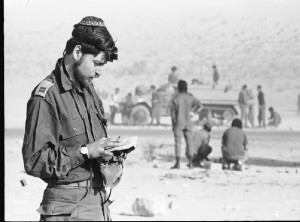
Divisional commander Ariel Sharon  consulting with
Lt. Gen. Chaim Bar-Lev and other officers on the southern front
 (Photo credit: GPO/ Flash 90)
The standard call-up system of the time was coded messages on the radio, during the weather reports if I remember correctly.  Now, that wasn't a problem on weekdays, or even on Shabbat for the non-religious, but once the security experts in the Israeli Government finally realized that war was expected, how could they send out the messages when there was no radio on Yom Kippur, and nobody would even think about turning it on?

Somehow via the few phone calls that were made and answered, buses began to gather at central parking lots in towns and cities throughout Israel.  And when ordinary Israeli reservists heard the rumbling of the buses, they understood that there was a major emergency.  Life was in danger, Pikuach Nefesh, and radios were turned on as reservists awaited instructions.

In our apartment building, we heard the siren and began rushing down the stairs to the miklat, shelter.  I had never been in it before.  I had my infant in either a carriage or playpen and had the very difficult job of trying to get a very elderly English-speaking neighbor to join us.  The absolute quiet, as typical of Yom Kippur in that religious neighborhood made it hard to explain that we needed to be in  the shelter but reinforced that, at least at that moment, we were safe.

As details began to be revealed, Jerusalemites were amazed to find themselves in one of the safest parts of the country.  Prior to the 1967 Six Days War, Jerusalem had always been on the frontline, one awful exposed to enemy-fire border.  Sniper and terror attacks were an expected part of Jerusalem life until the Six Days War ended and the IDF liberated the rest of Jerusalem, plus Judea, Samaria and the Jordan Valley aka "the west bank*," sic.


One of the great miracles of the Yom Kippur War was the fact that Jordan's King Hussein opted out.   Our forces were spread so thin that we may never had survived if we had to fight on three fronts.  Among the stories I heard from my neighbors, whose husbands were serving in the army, in the playground, while we cared for our young children, was that we had garbage trucks draped with camouflage fabric "patrolling" the Jordan border.  The muffler was adjusted to make as much noise and fumes as possible to give the impression that they were dangerous fighting vehicles.  You can call them the "Davidkas" of Yom Kippur 1973.
The Davidka (Yiddish: דוידקה, "Little David") was a homemade Israeli mortar used in Safed and Jerusalem during the early stages of the 1948 Israeli War of Independence. Its bombs were reported to be extremely loud, but very inaccurate and otherwise of little value beyond terrifying opponents; they proved particularly useful in scaring away Arab forces. It is nominally classified as a 3 inch (76.2 mm) mortar, although the bomb was considerably larger.[1][2]
Bli neder, no oath, more memories to come.
*When the late Morty Dolinsky was in charge of the Government Press Office in the 1980s, he once famously replied to a reporter, who asked for information about the West Bank, that he knew no West Bank as he banked at Leumi. Arutz 7

Monday, September 9, 2013

Rosh Hashannah Early? No, Right on Time

For those who run their lives according to the "goyish" aka solar or Christian Calendar, Rosh Hashannah, the Jewish New Year, which we just celebrated last week on September 5th came "very early."  Jewish schools in the northern hemisphere had to decide whether or not to open before their usual September date or earlier or later.  Yes, that includes Israel, where many schools started a week early so the children would have some educational preparation for Rosh Hashannah.

Many of us live rather schizophrenic lives when it comes to the calendar, and that includes yours truly.

I must admit that this morning when I went into the kitchen for my second mug bucket of coffee, and I noticed the dark grey clouds trying to mask the orange sunrise, I knew for sure that we are in the Month of Tishrei.


Rosh Hashannah is behind us and the Israeli fall has begun.  Our evenings and early mornings have been getting chillier and the days more humid.  This is typical weather for the season of the Jewish High Holidays, Rosh Hashannah and Yom Kippur.  Of course this summer-fall weather will yoyo for another month, and then G-d willing it will begin to rain.

When I stepped out the door to take more pictures of the sunrise I was impressed by how little of it I could see.  The trees are beginning to seriously block my view.


There was a time when standing in exactly the same spot I could see a lot more sky, but Baruch Hashem, thank G-d we've had rain, and the trees have been growing.

For those who schedule and function strictly according to the Jewish Calendar, there are no debates or discussions or even feelings that the Holidays are "early." That's because strictly speaking they aren't.  This is a year that will have a second Adar, which G-d willing will give us an extra month of rain and prevent the calendar situation the Muslims have.  Their holidays travel around the seasons, because they have an inflexible twelve month lunar calendar without any leap (extra) months.

Since Jewish Holidays are also entwined with specific harvests, we must celebrate them in their exact solar seasons.  The coordination of the two types of calendars, lunar and solar, in the Jewish Calendar is brilliant.  Another aspect of the calendar is that our two weeklong holidays, Succot and Passover begin with the full moon, in the middle of the lunar month.  All of this must match perfectly.

So, whether the Jewish Holidays are early or late depends on your "focus" or "lighting."  Two pictures I took this morning form the same spot illustrate it well.

Picture #1 was given an automatic flash by the camera.  The flash emphasizes the tree by my door and deemphasizes the sunrise.


Picture #2 So I quickly turned off the automatic flash and took another shot of the same scene.


Now I'll leave it in your hands.  Which should be called the Jewish Calendar and which the "goyish" calendar? 

Sunday, September 8, 2013

Jewish Prayer, In Quiet Dignity or Enthusiastic Participation

The online Tablet Magazine has an article about synagogue prayers and concerts, decorum and participation.
...Participatory services are more popular than services in which the congregation sits quietly for the most part, watching the rabbi and hazzan perform the work of worship up on the bimah.
Two: Tefillah was never meant to be a spectator sport, and by nature is the very opposite of a passive activity drained of emotion. We are talking about the attempt to stand before God, after all, however one understands God. This has never been an easy thing to do—consult the writings of religious virtuosi throughout the centuries—and is certainly not a routine matter for modern Jews in the pews. Nor is it easy to stand before oneself. The verb “to pray” in Hebrew is reflexive. Prayer is about exposing and facing up to depths of self, asking difficult questions and trying to answer them, pondering the meaning of God’s teachings for one’s life. The process can be uplifting, upsetting, or both. The tefillot we utter are meant to move us. At times the movement within has a chance to find expression in movement of the body—we bow, dance, sway, or parade around the synagogue. At other times, we keep what is inside bottled up, not wanting to reveal the turmoil...
It's certainly food for thought.  And it's a great relief to remember that there have always been many kinds and styles of synagogues and how they conduct prayers. The basic "rule" is, whether Orthodox, Reform, Conservative, Liberal, in Israel or Out, the more artistically skilled and expensive the Chazzan, Cantor, prayer leader, the less participatory, especially if there's a choir assisting. And that means that I'm extraordinarily lucky; our local synagogues enjoy the services of neighbors and guests, not professional Chazzanim.  


Even better for me is the fact that our Ezrat Nashim, Women's Gallery is upstairs.  I can sing happily along, "dance" in my place and nobody seems to care.  The men downstairs don't hear me, and nobody upstairs has dared to complain.  I don't bang on the seats, tables nor clap my hands. I try to be as quiet as can be knowing how easy it is to lose concentration when someone makes a loud startling noise.  Freed of the responsibility of leading public prayer, my female neighbors and I high up in the balcony have the freedom to sing happily out of tune when the mood suits us.  When my voice breaks from emotion, it's between me and G-d; I can switch volume at will.  We're neither performing nor responsible for inspiring the Tzibur, community in to prayer.  Yes, I do consider this a freedom.  I very sincerely thank G-d every morning when praying the Morning Blessings for making me "according to His Will."

Jewish Prayers are not supposed to be a disciplined "concert, " observed by a polite and mostly silent audience.  We, the congregation are supposed to say the prayers.  The chazzan, or less professional ba'al tefilah or Shaliach Tzibur, which means "messenger of the community," is supposed to facilitate, inspire us to pray to G-d.  According to Judaism we have a direct connection to G-d which we must use.

The Halachot Laws of Prayer are derived from the story of the Biblical Chana, Hannah in Shiloh.  And that is the story read in the Rosh Hashannah Haftara, 1 Samuel 1,1-2,10.
יב  וְהָיָה כִּי הִרְבְּתָה, לְהִתְפַּלֵּל לִפְנֵי יְהוָה; וְעֵלִי, שֹׁמֵר אֶת-פִּיהָ. 12 And it came to pass, as she prayed long before the LORD, that Eli watched her mouth.
יג  וְחַנָּה, הִיא מְדַבֶּרֶת עַל-לִבָּהּ--רַק שְׂפָתֶיהָ נָּעוֹת, וְקוֹלָהּ לֹא יִשָּׁמֵעַ; וַיַּחְשְׁבֶהָ עֵלִי, לְשִׁכֹּרָה. 13 Now Hannah, she spoke in her heart; only her lips moved, but her voice could not be heard; therefore, Eli thought she had been drunken.
Unlike most other pilgrims to the Mishkan, Tabernacle in Shiloh who requested that Eli or his sons pass their message, request, prayers to G-d, Chana prayed directly to G-d.  And Chana's request was granted.

When we pray directly to G-d, we connect to G-d and develop a relationship with Him. If we count on the cantor, then we're not communicating with G-d, and we miss out.  You don't need a great impressive voice for G-d to hear.  If we count on others to do our praying, we may end up creating a congregation of "tape recorders."
in Florida, This Happens
In a large Florida City, the rabbi developed quite a reputation for his sermons; so much so that everyone who was Jewish in the community came every Shabbat. Unfortunately, one weekend a member had to visit Long Island for his nephew's bar mitzvah. But he didn't want to miss the rabbi's sermon. So he decided to hire a Shabbat goy to sit in the congregation and tape the sermon so he could listen to it when he returned. Other congregants saw what was going on, and they also decided to hire Shabbat goys to tape the sermon so they could play golf instead of going to shul. Within a few weeks time there were 500 gentiles sitting in shul taping the rabbi. The rabbi got wise to this. The following Shabbat he, too, hired a Shabbat goy who brought a tape recorder to play his prerecorded sermon to the 500 gentiles in the congregation who dutifully recorded his words on their machines. Witnesses said this marked the first incidence in history of artificial insermonation!
And if we're supposed to communicate our prayers to G-d, then we must use a siddur with a language we understand.  The prayers in Israel, especially in shuls like mine, Beit Knesset Noam Yonatan in Ramat Shmuel, Shiloh,  are amazing.  One of the reasons for this was noticed by a young cousin who once spent a Shabbat with us.
"Everyone understands the words!"


Jewish Prayers are in Hebrew, and Hebrew is the language spoken by most of my neighbors.  We're not mumbling, or even singing in gibberish.  When I've been a guest in homes in which the person saying Kiddush or Havdalah doesn't comprehend Hebrew, the prayer sounds different.  So, one of the ways to connect to Jewish Prayer is to learn Hebrew. And in the interim, keep checking up on the translation.